Here's a neat little video that explains how complexity can come about in through evolution. The animations on this are very well done! I enjoyed the bit about the sundew.
Showing posts with label Evolution. Show all posts
Showing posts with label Evolution. Show all posts
Wednesday, 1 December 2010

Thursday, 3 June 2010
Why we love baby moose, and our relation to baby chimps

Neoteny is a concept in developmental biology, whereby the development of an organism is delayed, maybe indefinitely. It will continue to progress into a reproducing individual, however. Where before, a wolf would have progressed through its youth and grown up into a proper bitch or dog (allegedly, dog is the term for a male hound or wolf. You learn something new every day!), the selective pressures put on the proto-domesticated wolf lead to animals of increasingly delayed development, in all but reproduction. The maturation of a wolf leads to a closed social circle; some breed owners are familiar with this, where some animals such as many Karelian Bear dogs are eternally suspicious of outsiders. A domesticated animal should, in general, be flexible as to its social environment, and should have a much longer learning and socialization period than their wild counterparts.

Additionally, the proportions these baby animals hijack our human brains as I'd previously mentioned. The reason is simple - neotenic animals have the same sort of exaggerated features, generally, and humans need to look after their babies. Therefore, the same traits that make humans fawn over babies, and give them the attention those human babies need, lead to us fawning over fawns, kittens, puppies, and so forth. They highjack a vital mental pathway required for our own care of our young, in a very inadvertent way. Even many hunters who intellectually prefer the taste of calf meat have a hard time shooting calf caribou or moose. One person described a recent photo as `somehow being cute, and making him be hungry all at once.` What phenomenally contradictory thoughts! On one side, they adore the helpless reindeer calf, but simultaneously existing with his view of reindeer as something intrinsically food. This isn't merely the luxury of softhearted modern humans, as the impulse has been around for probably as long as there has been humans, if not a little before.
The actual evolutionary mechanism is fairly simple. Delay, delay, delay. It's apparently easy to move the date of maturation back almost indefinitely, as it's happened so many times, and in so many species. Humans are incredibly neotenic apes - if you compare our facial dimensions to that of a foetal chimpanzee, you'll find the comparison more than somewhat disquieting. A favourite professor of mine once stated that humans are just extra-uteral foetuses, lumbering about on our way. The reason why this is in humans is similar why hounds have had their development pushed back - learning and socialization. Humans are some of the most intensely social primates, with general monogamy (although genetic monogamy is another issue, as Jerry Springer is a testament to), and we're intensely intelligent primates... well, Jerry Fallwell aside.

In order to accommodate this brainy super-sociality, we've needed to extend our brain developmental period for nearly two decades, and after two decades our brains are constantly breaking down and forming new connections as we learn. Apparently, one of the easiest ways to this state was to push back our total maturation, making our adults more and more like large versions of chimpanzee foetus. In fact, our development in the womb is so long that a large chunk of it needs to be done outside the womb. It's all human babies who are born premature (although some more than others).
It's not just mammals that use neoteny as a trick to jump on new and clever evolutionary trajectories. Some amphibians are permanently juvenile, never losing their gills, or developing lungs. Instead, the species retains a permanent presence in the water as a new young would have. Large flightless birds have been noted have many of the portions of a chick of flighted species. And domestication and neoteny seemed to be tightly coupled, as the tame silverfox experiment resulted in rather neotenic foxes. Neoteny is a powerful evolutionary too, employed time and time again when the Peter Pan approach appears the wisest - sometime it's best never to really "grow up."
The photo of the Chimpanzee is from 1926 study by Adolf Naef.
Thursday, 18 March 2010
On the Origins of Polar bears

From PNAS March 16, 2010 vol. 107 no. 11 5053-5057 "Complete mitochondrial genome of a Pleistocene jawbone unveils the origin of polar bear" Lindqvist et al. 2010.
The polar bear has become the flagship species in the climate-change discussion. However, little is known about how past climate impacted its evolution and persistence, given an extremely poor fossil record. Although it is undisputed from analyses of mitochondrial (mt) DNA that polar bears constitute a lineage within the genetic diversity of brown bears, timing estimates of their divergence have differed considerably. Using next-generation sequencing technology, we have generated a complete, high-quality mt genome from a stratigraphically validated 130,000- to 110,000-year-old polar bear jawbone. In addition, six mt genomes were generated of extant polar bears from Alaska and brown bears from the Admiralty and Baranof islands of the Alexander Archipelago of southeastern Alaska and Kodiak Island. We show that the phylogenetic position of the ancient polar bear lies almost directly at the branching point between polar bears and brown bears, elucidating a unique morphologically and molecularly documented fossil link between living mammal species. Molecular dating and stable isotope analyses also show that by very early in their evolutionary history, polar bears were already inhabitants of the Artic sea ice and had adapted very rapidly to their current and unique ecology at the top of the Arctic marine food chain. As such, polar bears provide an excellent example of evolutionary opportunism within a widespread mammalian lineage.

See, there are two issues. First is that identification is based on morphology. It looks like a polar bear skull, therefore progenitor polar bears looked like modern polar bears. On the other hand, you would see nothing if progenitor polar bears looked like modern brown bears, because we'd mis-classify them as arctos instead of maritimus. Therefore, the study could only find that polar bears were more like modern polar bears in morphology. Connected to this issue is that given the only the left mandible (jawbone) could be recovered. Granted, that's more than what we'd have otherwise, as polar bear remains are rare (As things that hangs out around water tend to be!). Still, it may be premature to state that this is substantial morphological evolution.

There are messages I'm taking home, though. First, the date of the split of the species. I'll buy it based on the stratigraphy, the tree they generated, and how well it jives with the rest of the evidence. This makes polar bears a really recent species (not that we had any suspicions to the contrary!), which is interesting. Second, whole mtDNA genome sequencing for ancient remains: even cooler than I thought it was. Third, polar bears had a polar bear diet when they split. Pretty dang cool right there. As for the course of evolution of the polar bear, I remain somewhat sceptical and hesitant to accept their conclusions.
Edit to add: Oh, wow, am I embarrassed! I posed the wrong skull comparison! The one I have above is arctos and americanus! That's entirely wrong! Here's a proper polar bear skull!

Lindqvist, C., Schuster, S., Sun, Y., Talbot, S., Qi, J., Ratan, A., Tomsho, L., Kasson, L., Zeyl, E., Aars, J., Miller, W., Ingolfsson, O., Bachmann, L., & Wiig, O. (2010). Complete mitochondrial genome of a Pleistocene jawbone unveils the origin of polar bear Proceedings of the National Academy of Sciences, 107 (11), 5053-5057 DOI: 10.1073/pnas.0914266107
Tuesday, 3 November 2009
The snack-raficing of squirrels
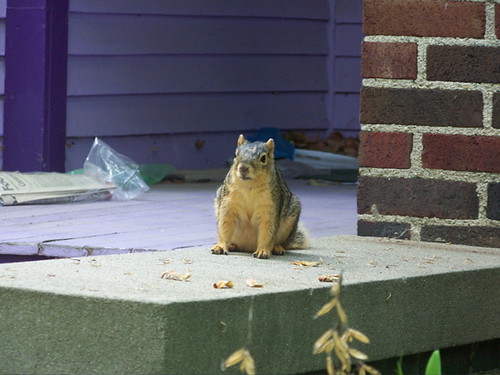 Where does altruism evolve from? It's a legitimate scientific question, because altruism appears to fly in the face of natural selection.
Why should a ground squirrel give an alarm call at the sight of a hawk, which raises her chances of being eaten by the hawk? She should duck and cover, to save her own skin.
These questions long since puzzled people who study behaviour, since the trait should become rare in the genepool as these self-snack-raficing individuals are digested and turned into parts for baby hawks. In the end, there should be nothing left but the squirrels that get the heck out of dodge.
The beginning of our understanding of apparent altruism among animals came when people began understanding fitness better. The ground squirrel could be a mother, trying to save her offspring. If she can save them easier than she can produce more pups, then she should do that. Putting it mathematically, she should act when
B>C*i
Where B is benefit, C is cost and i is rIsk. In this case, the benefit is past reproductive success - potential grand-offspring to carry her traits into the future. The cost is how much she'll pays - all the future potential offspring she could make. And the rIsk is the probability that she'll have to pay that cost. The cost can be very high, but if the risk is low, you don't need much benefit to justify the action.
W.D. Hamilton formalized this even better, with Hamilton's rule (imaginatively named) where a trait (such as this self-snack-raficing behaviour) is expected to become more common in a population when the inequality is satisfied:
r*B>C*i
Where r is probability that the recipient of the actor has the trait. From our understanding of Mendelian genetics, this is .5 for parent-offspring, .5 for sibling-sibling pairs, .25 for half-siblings or Grandparent-Grandoffspring. There are some interesting exceptions to these rules that I'll mention in a future post.
So, in plain English, if we define all the future offspring our Ground squirrel can have as being 1, and assume 100% risk, then the other ground-squirrel she saves should be worth 2 times that many offspring if if the altruistic squirrel is a parent. Along these lines, J.B.S. Haldane was once asked if he'd give his life to save his brother. Jokingly, he replied "Would I lay down my life to save my brother? No, but I would to save two brothers or eight cousins."
Of course, there's far more to altruism than this; we call this principle `kin selection`, where evolutionary impact isn't just from one's own offspring, but from an organism's blood-family members as well. The description of kin selection went a long way to explaining how many forms of altruism we find among animals evolved.
You can find some extreme examples of this in some insects, where queens produce sterile workers. These sterile workers get all their evolutionary fitness from the queen's success, and none through their own reproduction (Because they can't). Because the cost is so low (they'll never have offspring), it doesn't take much benefit to justify extreme actions. In this system, bees with stingers evolve. They die when they use them, but they manage to advance the queen's reproductive fitness just a little more in doing so.
Interestingly, because of bees breeding system, the workers are more related to the female future-queens than the reproductive males. Because of this, the workers siphon off resources from the males larva and invest it in the female larva. There's insurrection in the beehive!
Tuesday, 27 October 2009
MHC and stinky t-shirts.
I'm going to talk about human behaviour and evolution here. Remember my disclaimer! Don't commit the is-ought fallacy!
 Go ahead. Go smell your significant other. I'll wait! Back. Smell good, don't they? Unless they're splitting wood, or something. Even then, I bet they smell better to you than anyone else while splitting wood.
This isn't a coincidence. Human mate choice is governed by quite a bit, and part of the `goal` is to mate disassortatively. That is, you don't want to mate with close relatives. Part of what helps you avoid inbreeding is MHC. Wait, isn't MHC the thing I mentioned earlier to help your immune system? It's the same! It also helps you pick mates. Versatile, eh?
We suspect MHC because of a few experiments. The first, by Wedekind et al. in 1995, had men wear t-shirts for two nights without washing. After that, the t-shirts were sealed in bags, and were presented to a number of women, who were to asked to rate the smells. Wedekind and colleagues collected the questionnaires, and some DNA from both the men and the women, to find out which type of MHC they had. They found that the women rated men with different MHC types as being more pleasant.
 People were resistant to this study, because of the long-held wisdom that MHC was for the immune system only. Eventually, the study was replicated in Brazil by Santos et al. (in 2005), except using sweat directly instead. Critics cried that sure, there might be an inclination, but surely other factors weigh out in the final mate choice. Well, we have reason to believe these turn into actual matings - Ober and colleagues analysed marriage patterns in Hutterite communities and concluded that people tended to marry individuals with different MHC types.
Interestingly, MHC also seems to predict fragrence preference in perfume Milinski and Wedekind found that MHC type predicted the type of fragrance people preferred for themselves. This predictive power didn't hold over to preferences for partner fragrance. But this is, in a way, expected: for self, perfume is advertising one own MHC complement. For others, it doesn't matter what MHC they have, so long as it's different from your own.
Humans aren't the only critters who tend to marry/mate this way. Mice (Potts et al. 1991) tend to do that, as to Fat-Tailed leamurs (Schwensow et. al 2007), and fish such as Three-spined sticklebacks (Reusch et al 2001). There are many other species that have been studied, and this pattern found - though others where it hasn't. It's important to note the magnitude of the mate selection bias varies among species to levels difficult to detect.
It's worth noting that finding MHC disimilar mates is not a hard thing to do. If this was just to keep offspring MHC diverse, it'd probably be easier to pick an individual at random - they've got a low probability to be MHC similar. All human groups have a large amount of MHC diversity, and it's been well conserved through most human lineages. Truly, the only purpose this could serve is to avoid mating with those similar to ones-self - such as close relations. Today, avoiding inbreeding might seem trivial, but you don't have to go far back in human history to have a situation where two individuals don't know how related they are to eachother, because of incomplete genealogical knowledge. If you're a ground squirrel, life is even harder, knowing who your family is!
But if you're a ground squirrel, how are you reading this blog?
It's interesting to think that this is all going on without our being aware. Aside from some researchers, I don't think anyone out there is thinking, "Gosh, this person is right for me, because their MHC is clearly quite different from mine!" This is all going on inside our nose and brain without us even being aware of it. This is just one of many things we smell, but aren't quite completely aware of - the more we learn, the more it seems we're some of the worst judges of why we do things!
Bonus points to anyone who recognizes the movie clip. :)
 Go ahead. Go smell your significant other. I'll wait! Back. Smell good, don't they? Unless they're splitting wood, or something. Even then, I bet they smell better to you than anyone else while splitting wood.
This isn't a coincidence. Human mate choice is governed by quite a bit, and part of the `goal` is to mate disassortatively. That is, you don't want to mate with close relatives. Part of what helps you avoid inbreeding is MHC. Wait, isn't MHC the thing I mentioned earlier to help your immune system? It's the same! It also helps you pick mates. Versatile, eh?
We suspect MHC because of a few experiments. The first, by Wedekind et al. in 1995, had men wear t-shirts for two nights without washing. After that, the t-shirts were sealed in bags, and were presented to a number of women, who were to asked to rate the smells. Wedekind and colleagues collected the questionnaires, and some DNA from both the men and the women, to find out which type of MHC they had. They found that the women rated men with different MHC types as being more pleasant.
 People were resistant to this study, because of the long-held wisdom that MHC was for the immune system only. Eventually, the study was replicated in Brazil by Santos et al. (in 2005), except using sweat directly instead. Critics cried that sure, there might be an inclination, but surely other factors weigh out in the final mate choice. Well, we have reason to believe these turn into actual matings - Ober and colleagues analysed marriage patterns in Hutterite communities and concluded that people tended to marry individuals with different MHC types.
Interestingly, MHC also seems to predict fragrence preference in perfume Milinski and Wedekind found that MHC type predicted the type of fragrance people preferred for themselves. This predictive power didn't hold over to preferences for partner fragrance. But this is, in a way, expected: for self, perfume is advertising one own MHC complement. For others, it doesn't matter what MHC they have, so long as it's different from your own.
Humans aren't the only critters who tend to marry/mate this way. Mice (Potts et al. 1991) tend to do that, as to Fat-Tailed leamurs (Schwensow et. al 2007), and fish such as Three-spined sticklebacks (Reusch et al 2001). There are many other species that have been studied, and this pattern found - though others where it hasn't. It's important to note the magnitude of the mate selection bias varies among species to levels difficult to detect.
It's worth noting that finding MHC disimilar mates is not a hard thing to do. If this was just to keep offspring MHC diverse, it'd probably be easier to pick an individual at random - they've got a low probability to be MHC similar. All human groups have a large amount of MHC diversity, and it's been well conserved through most human lineages. Truly, the only purpose this could serve is to avoid mating with those similar to ones-self - such as close relations. Today, avoiding inbreeding might seem trivial, but you don't have to go far back in human history to have a situation where two individuals don't know how related they are to eachother, because of incomplete genealogical knowledge. If you're a ground squirrel, life is even harder, knowing who your family is!
But if you're a ground squirrel, how are you reading this blog?
It's interesting to think that this is all going on without our being aware. Aside from some researchers, I don't think anyone out there is thinking, "Gosh, this person is right for me, because their MHC is clearly quite different from mine!" This is all going on inside our nose and brain without us even being aware of it. This is just one of many things we smell, but aren't quite completely aware of - the more we learn, the more it seems we're some of the worst judges of why we do things!
Bonus points to anyone who recognizes the movie clip. :)
Tuesday, 21 July 2009
Cauga una?

I was sure that one of my European readers would pipe up with the answer to the skull to the right! Alas, it wasn't the case. Not only is the animal depicted to the right not from the Pleistocene, but it's still around today. Believe it or not, this animal is a deer. Yes, it's a sabre-toothed deer, around and well in the modern world! It's proper name is the Chinese Water Deer (Hydropotes inermis), and obviously it doesn't have a name yugcetun.
I'm really sorry I don't have any pictures for myself of this animal, at least none that aren't in books, but here are two from wikimedia that I can share with you all, to give you an idea what the fang-ity deer look like:


So impressive!
What's interesting is that their family, Cervidae, are known as the antlered deer. However, the Chinese Water Deer lacks antlers throughout its life. Even the Tufted Deer, who's antlers sometimes don't protrude through the head-fur, has a more impresive rack than the Chinese Water Deer. They don't represent an especially old group of animals - my phylogeny on my wall doesn't have them having an especially "basal node," - meaning they didn't split off from from the rest of the deer far back in time. In fact, moose are far more 'basal' than the Chinese Water deer.
These atavistic critters give us clues about how deer probably were like before they evolved antlers. They're largely solitary through most of the year, spending their time in association with wetlands, feeding. However, in the rut the males will periodically encounter eachother, where they try to impress other males with the size and symmetry of their tusks. If they're unimpressed, a bout of often bloody fighting with commence, until either a deer is dead, or runs away. Far be it from them to just mess up eachother, periodically, a Chinese Water deer will sometimes seriously gore a dog in China, or in introduced populations in the UK and France.
Here's one for this week!
 Cauga una? I have no idea what it is, but I'll find out before next tuesday! :p
Friday, 17 July 2009
Domestication of Foxes
 Since the last two posts have been fox pictures, why not some fox-related science? Also, I found someone else's write up, and it reminded me about just how cool an experiment was...
For a long time, people observed that domesticated animals seemed to possess a constellation of traits - depigmentation, floppy ears, dwarf form, and retention of juvenile characteristics - in at least some breeds, if not all the breeds. Darwin himself made particular note of it when he wrote "The Variation of Animals and Plants Under Domestication," one of his lesser known volumes. I just recently read that he noted the bit about floppy ears in "On the Origin of Species," but I must have missed that - which is easy to do, given how much he wrote!

Now in the late 1940s to late 1950s, there was a Russian named Dmitri Belyaev, who had the notion that perhaps we'd been thinking about domestication all wrong. Up until that point, many people had been thinking about it in terms of large macroscale traits that are easily measurable - size of the pup, whether it has blue eyes, or a sickle tail. The thinking went over time we selected for the traits which made dogs, which resulted in the beasts we have today. This is no doubt true, but Dmitri's insight was to think at a higher level - what if domestication happened by first selecting for broad behavioural traits - things like "Tamenes" and "lack of fear of humans."
 The field of behavioural ecology hadn't yet been codified, and the link between behaviour was poorly appreciated then. It can't be understated what an intuitive leap this was.
Dmitri also had the serious disadvantage of being a geneticist in the soviet era of Lysenkoism: Lysenkoism was the (erroneous) belief that acquired traits could be heritable between generations. If that smells like Lamark, you're not far off. Trofim Lysenko had the great advantage of being a ardent communist and supporter of Leninism. He was put in a position of power and influence in Soviet Russia, and Lysenkoism became the official scientific dogma of Russia for quite some time. This wouldn't have been that big of a set back except for two things. First, he was an agricultural scientist, and Trofim oversaw quite a few instances of massive crop failure. His responses were frequently pointless, and more aimed at grandstanding than anything rooted in science. Starvation was an issue. Secondly, over time the geneticists became more and more alienated. They were denounced as Bourgeois elitists (gosh, that sounds familiar...) and with Stalin's blessing, the Russians began executing several, arresting others, and merely firing still others. Dmitri was lucky not to be shot for his ideas.
 The experiment was fairly straight forward: Take a large number of foxes (~150), and select the 5% most tame males, and 30% most tame females for breeding. This was repeated generation after generation, selecting for tameness by ejecting animals that showed aggression towards humans from the experiment, and ranking the remaining animals on how afraid they were of humans.
The experiment proceeded very quickly. Within a very small number of generations, animals began behaving amenably toward humans. While inbreeding was a serious concern, they calculated that inbreeding was actually rather low (2% to 7%), and without knowing a lot about fox dispersal, I would be inclined to say that's lower than wild levels. Over time, the genetic traits that lend themselves to making an animal sociable were enriched. 40 Years after the project started, most of the animals were in the "social elite" - that is to say, they actively sought out human interaction. They would wag, they would bark, they would lick human faces. Behaviourally, they never left the puppy-period of being socializable.
 Curiously, after a number of generations (I believe 5, but I don't have a primary source on hand), they began to see some traits that where rarely seen in the wild become quite common among their experimental animals. The sickle tail, where the tail is turned up, drooping ears, a depigmented "star" on their forehead which appeared white, and uneven colouration. You can click on the picture to the right to enbiggen it and see the traits. That animal in the bottom right corner isn't a Border Collie - it's a fox.
The explanation for the arrival of these traits is pretty clever. I'm going to compare it to working on your boat. Let's say you want to make your boat go faster. The first thing you can do is to pluck some low hanging fruit - clean off the hull, for example. But after you do the basic, easily done things, all you have left are major alterations to either the form of the hull - maybe reshaping it - or tinkering with your outboard. When you start doing that, you start changing other characters of your boat, too. Sure, you might
 have souped up your honda to go real fast, but now you'll get terrible gas mileage.
Selecting for complex traits like "tameness" is a lot like messing with your boat. After you've done all the easy things, and made them as tame as you can without actually changing much, all there is left is messing with components that will effect a lot of other things. Yes, Adrenaline plays a serious role in aggression and fear, but it has precurses that play roles in hair pigment. So by fiddling with the production of adrenaline, you're also causing these changes in pigmentation.
Sadly, Dmitri didn't live long enough to see his experiment really become the blockbuster it became. He died in 1985, after seeing signs that his ideas were spot on. His views of genetics (obviously) were vindicated, and the Soviet Union began backing off Lysenkoism in the 60s. Their biological sciences program never really recovered from the expulsion and murder of people who studied evolution by natural selection. With the collapse of the Soviet Union, the group still running his experiment became hard for money, and culled quite a few animals. The remainder they subsidize by selling fully domesticated Silver Foxes as pets to the rich. I can only imagine what an animal as smart as a fox would do turned loose in someone's home - if cats can learn to turn doorknobs, imagine what a fox could do!
Photocredits: First three from Wikimedia. First two figures from Belyaev 1978. Final figure from Trut 1999. Idea from the post came when I stumbled on this while looking for DIY airconditioner blueprints.
Tuesday, 14 April 2009
Human behaviour and fallicious thinking
I want to write about some human research, but first I want to put up a huge disclaimer. Normally, I find humans boring, because compared to other animals, we're a bunch of inbred backwoods blue bloods who all look the same, and while a few humans are pretty to look at, ducks don't have the police grab you when you stalk them.
There are a few bits of our biology that's neat, though. Did you know you can probably run distances that would kill a chetah? Did you know the invention of fire caused significant changes in our mandible structure? And did you know that humans can smell when a female mammal is ovulating, but don't even consciously know that they're smelling it? And you thought you knew your own body!
But whenever you talk about humans, and human behaviour (as I'd like to), you need to walk a fine trail. Back in the mid 70s, E.O. Wilson wrote a book titled `Sociobiology: The New Synthesis,` which erupted into a fire storm. The book attempted to explain the evolutionary mechanics behind various social behaviours, like aggression, altruism, nurturing, and preference to kin. And it did a fine job - history has shown E.O. Wilson to be almost entirely right about most of the ideas in there. Where E.O. Wilson got into trouble was in a single chapter, where he took all the methods he applied on other animals, and used them on humans to show our behaviour could be explained evolutionarily.
People were outraged. There were actually protests at scientific conferences. It was astounding, the visceral reaction that the book prompted in people. Politicians also dived in, denouncing poor old Edward (who is quite a gentleman) as all manner of vile thing.
Part of the problem comes from an issue called `biological determinism,` or the pervasive belief that how an organism (such as us humans) behaves is explained entirely by that critter's DNA. A behavioural ecologist (which was my first training) would reply that an organism's genes, and cultural environment, explains much, though not all, of it's behaviour. A critter's biology would most strongly explaining stereotyped behaviour, especially - things we all tend to do, like smiling, yawning, sleeping, sharing food with kin, etc.
A second part of the problem is that critics tend to assume that because we say a behaviour is evolutionarily advantageous, it is morally acceptable. A common example would be if we're evolved to give our offspring everything we can to help them succeed, then nepotism is okay. Taken to the logical absurd, if we discovered that murders lived longer, and were more fit, that would morally justify murder.
This is total anaq.
What people are doing is committing the is-ought fallacy, and the "Naturalistic fallacy." There's a neat wikipedia page on it under that name. There's a implicit step in their reasoning that says that how things currently are is in fact morally desirable, or that the natural state of things, if biologically advantageous, is desirable.
Morality is for the philosophers to quibble over, not behaviourists. What biology seeks to do is explain why things are the way they are, not whether it's good, bad, or indifferent. The fact that viruses reproduce by hijacking our cells to manufacture more of themselves isn't a moral ponderance, but a declarative statement. Science doesn't root for either the wolf or the moose - we don't take sides like that. If we found out that humans are evolutionarily predisposed to commit murder, that isn't saying it's morally acceptable to murder, just that the existence of murder among all humans has an explanation. That's like saying because the robber has an explanation why they robbed the bank, we would excuse it morally. It's just bad reasoning.
That's my disclaimer. If you don't like any of the human stuff I write, you don't have to. I don't like gravity some mornings. But keep in mind because something is described as being "X," doesn't mean we have to like it, or agree with it.
Here's some topics I want to cover:
Picking mates and MHC.
How seasons affect our standards.
Humans as cursorial mammals.
There are a few bits of our biology that's neat, though. Did you know you can probably run distances that would kill a chetah? Did you know the invention of fire caused significant changes in our mandible structure? And did you know that humans can smell when a female mammal is ovulating, but don't even consciously know that they're smelling it? And you thought you knew your own body!
But whenever you talk about humans, and human behaviour (as I'd like to), you need to walk a fine trail. Back in the mid 70s, E.O. Wilson wrote a book titled `Sociobiology: The New Synthesis,` which erupted into a fire storm. The book attempted to explain the evolutionary mechanics behind various social behaviours, like aggression, altruism, nurturing, and preference to kin. And it did a fine job - history has shown E.O. Wilson to be almost entirely right about most of the ideas in there. Where E.O. Wilson got into trouble was in a single chapter, where he took all the methods he applied on other animals, and used them on humans to show our behaviour could be explained evolutionarily.
People were outraged. There were actually protests at scientific conferences. It was astounding, the visceral reaction that the book prompted in people. Politicians also dived in, denouncing poor old Edward (who is quite a gentleman) as all manner of vile thing.
Part of the problem comes from an issue called `biological determinism,` or the pervasive belief that how an organism (such as us humans) behaves is explained entirely by that critter's DNA. A behavioural ecologist (which was my first training) would reply that an organism's genes, and cultural environment, explains much, though not all, of it's behaviour. A critter's biology would most strongly explaining stereotyped behaviour, especially - things we all tend to do, like smiling, yawning, sleeping, sharing food with kin, etc.
A second part of the problem is that critics tend to assume that because we say a behaviour is evolutionarily advantageous, it is morally acceptable. A common example would be if we're evolved to give our offspring everything we can to help them succeed, then nepotism is okay. Taken to the logical absurd, if we discovered that murders lived longer, and were more fit, that would morally justify murder.
This is total anaq.
What people are doing is committing the is-ought fallacy, and the "Naturalistic fallacy." There's a neat wikipedia page on it under that name. There's a implicit step in their reasoning that says that how things currently are is in fact morally desirable, or that the natural state of things, if biologically advantageous, is desirable.
Morality is for the philosophers to quibble over, not behaviourists. What biology seeks to do is explain why things are the way they are, not whether it's good, bad, or indifferent. The fact that viruses reproduce by hijacking our cells to manufacture more of themselves isn't a moral ponderance, but a declarative statement. Science doesn't root for either the wolf or the moose - we don't take sides like that. If we found out that humans are evolutionarily predisposed to commit murder, that isn't saying it's morally acceptable to murder, just that the existence of murder among all humans has an explanation. That's like saying because the robber has an explanation why they robbed the bank, we would excuse it morally. It's just bad reasoning.
That's my disclaimer. If you don't like any of the human stuff I write, you don't have to. I don't like gravity some mornings. But keep in mind because something is described as being "X," doesn't mean we have to like it, or agree with it.
Here's some topics I want to cover:
Picking mates and MHC.
How seasons affect our standards.
Humans as cursorial mammals.
Wednesday, 19 November 2008
Dave's Lizards
I keep saying I'll write up the darn lizard paper, yet every time I start, it slips through the cracks. Tonight, no more! With a good half hour until House starts, I've sat down and given this a good discussion.
Evolution! If you don't think it's a trick by Satan, chances are you think that evolution takes place on a geologic timescale. Surely nothing we can witness, eh? Well, not so. By being clever naturalists, me and you can ferret out the signature of evolution, and catch it in the process of doing its thing.
Previously, I talked about speciation, and how we can catch it in the process with fish in Lake Victoria, but while there was some morphological change with that - the fish got a little different in their colour - it wasn't very flashy. When we think of evolution, even most scientists think of anatomical change. We want them to look really different, darn it!
That sort of evolution is much, much slower to come about. Adaptive evolution is a slow process of variation and selection. Sometimes it might take sudden leaps, but that's fairly rare (Sorry Gould). However, if selection is strong - meaning that some variants are much `better` than others - then evolution can occur rapidly.
We've previously seen examples, but few are very gee-wiz amazing. Channel Island deer mice showed rapid change of head characters and body size, Darwin's Finches showed rapid evolution of beak and body size, and Black Snakes showed rapid adaptation to an invasive toad, the Cane Toad. Harrel et. al 2008 are about to blow all their competitors socks off.
In 1971, a couple of scientists took 5 male lizards, and 5 female, and transplanted them on an island called Pod Mrcaru. They hadn't been there before, and where they were, before (Pod Kopiste), they were small bug-munchers, with males who kept territories. Thus far, a boring experiment. But then war broke out.
Said war went on for a bit, and prevented people from really heading back to the island to check on what's up with them. It took them about, oh, 36 years for them to get in on back and check, when all was said and done. And in that time, these lizards (Podarcis sicula) were in a novel environment, with new pressures to survive, and new food sources available. Natural selection did its thing.
When they did come back, they found that when it comes to shape, the lizards had signifigantly wider, taller and longer heads. Further, the lizards on the new island ate a large portion of vegetation, from 4-7% to about 34-61% (spring-summer). And the vegetation were things like leaves and stems.
Not so visible from the outside, the lizards underwent a rapid change in gut structure, with a whole new structure that wasn't really there before: They evolved caecal valves. This is huge. This is amazingly big. It would be like humans suddenly starting to grow articulated, functional tails again. In about 30 generations, they went from insectivorous to having plant-adapted digestive tracts.
Oh. And the males? Went from territoral to not. This seems to have changed the sprint speed, limb length, and god-knows-what-else-we-haven't-measured.
30 generations. To put that in context, 30 human generations would be about, oh, 900 years. So it'd be like if in the time since 1100CE, humans changed shape. It seems absurd, but under strong selective pressure, that's what happens.
Oh, I suppose that begs the question, `why don't you see that in other species? Why are all humans pretty much the same, when we've been separated for about 400 generations?`
Well, the selective pressure needs to be big - the difference in success between the lizard with the features and the one without needs to be pretty serious. Second, there needs to be not a lot of wiggle room - this actually goes to point A. Humans, for example, are amazingly plastic. We don't need many physiological changes, when we can accommodate so much by just changing our learned behaviour just slightly.
Third, the variation needs to happen - if no one gets the mutation giving them that third eye, third eyes aren't going to evolve, no matter how cool they are. This is actually a bigger deal than most people would guess. Finally, there can't be much geneflow. Remember whole thing about speciation? It lets groups adapt to their micro-enviroment without getting genes from individuals outside that environment. Geneflow carries information around, and makes groups more similar. So it has the tendency to wash out local adaptation.
These lizards had big selective pressure, not a lot of plasticity, the variation happened, and because they were on an island, the geneflow didn't happen. So what we saw was rapid divergence, and a really neat paper in PNAS. ;)
Herrel, A., Huyghe, K., Vanhooydonck, B., Backeljau, T., Breugelmans, K., Grbac, I., Damme, R., and Irschick�, D. (2008) Rapid large-scale evolutionary divergence in morphology and performance associated with exploitation of a different dietary resource. Proceedings of the National Academy of Science, v.105(12), pp. 4792–4795.
Evolution! If you don't think it's a trick by Satan, chances are you think that evolution takes place on a geologic timescale. Surely nothing we can witness, eh? Well, not so. By being clever naturalists, me and you can ferret out the signature of evolution, and catch it in the process of doing its thing.
Previously, I talked about speciation, and how we can catch it in the process with fish in Lake Victoria, but while there was some morphological change with that - the fish got a little different in their colour - it wasn't very flashy. When we think of evolution, even most scientists think of anatomical change. We want them to look really different, darn it!
That sort of evolution is much, much slower to come about. Adaptive evolution is a slow process of variation and selection. Sometimes it might take sudden leaps, but that's fairly rare (Sorry Gould). However, if selection is strong - meaning that some variants are much `better` than others - then evolution can occur rapidly.
We've previously seen examples, but few are very gee-wiz amazing. Channel Island deer mice showed rapid change of head characters and body size, Darwin's Finches showed rapid evolution of beak and body size, and Black Snakes showed rapid adaptation to an invasive toad, the Cane Toad. Harrel et. al 2008 are about to blow all their competitors socks off.
In 1971, a couple of scientists took 5 male lizards, and 5 female, and transplanted them on an island called Pod Mrcaru. They hadn't been there before, and where they were, before (Pod Kopiste), they were small bug-munchers, with males who kept territories. Thus far, a boring experiment. But then war broke out.
Said war went on for a bit, and prevented people from really heading back to the island to check on what's up with them. It took them about, oh, 36 years for them to get in on back and check, when all was said and done. And in that time, these lizards (Podarcis sicula) were in a novel environment, with new pressures to survive, and new food sources available. Natural selection did its thing.
When they did come back, they found that when it comes to shape, the lizards had signifigantly wider, taller and longer heads. Further, the lizards on the new island ate a large portion of vegetation, from 4-7% to about 34-61% (spring-summer). And the vegetation were things like leaves and stems.

Not so visible from the outside, the lizards underwent a rapid change in gut structure, with a whole new structure that wasn't really there before: They evolved caecal valves. This is huge. This is amazingly big. It would be like humans suddenly starting to grow articulated, functional tails again. In about 30 generations, they went from insectivorous to having plant-adapted digestive tracts.
Oh. And the males? Went from territoral to not. This seems to have changed the sprint speed, limb length, and god-knows-what-else-we-haven't-measured.
30 generations. To put that in context, 30 human generations would be about, oh, 900 years. So it'd be like if in the time since 1100CE, humans changed shape. It seems absurd, but under strong selective pressure, that's what happens.
Oh, I suppose that begs the question, `why don't you see that in other species? Why are all humans pretty much the same, when we've been separated for about 400 generations?`
Well, the selective pressure needs to be big - the difference in success between the lizard with the features and the one without needs to be pretty serious. Second, there needs to be not a lot of wiggle room - this actually goes to point A. Humans, for example, are amazingly plastic. We don't need many physiological changes, when we can accommodate so much by just changing our learned behaviour just slightly.
Third, the variation needs to happen - if no one gets the mutation giving them that third eye, third eyes aren't going to evolve, no matter how cool they are. This is actually a bigger deal than most people would guess. Finally, there can't be much geneflow. Remember whole thing about speciation? It lets groups adapt to their micro-enviroment without getting genes from individuals outside that environment. Geneflow carries information around, and makes groups more similar. So it has the tendency to wash out local adaptation.
These lizards had big selective pressure, not a lot of plasticity, the variation happened, and because they were on an island, the geneflow didn't happen. So what we saw was rapid divergence, and a really neat paper in PNAS. ;)
Herrel, A., Huyghe, K., Vanhooydonck, B., Backeljau, T., Breugelmans, K., Grbac, I., Damme, R., and Irschick�, D. (2008) Rapid large-scale evolutionary divergence in morphology and performance associated with exploitation of a different dietary resource. Proceedings of the National Academy of Science, v.105(12), pp. 4792–4795.
Wednesday, 8 October 2008
Specious speciation!
I was just thinking the other day that I hadn't done a hard science post in a bit, because nothing had really struck me as interesting. And then I found an article in last week's edition of the Journal Science, and I'm cured! :}
Here, Seehausen et al (2008) discussed evidence for a controversial form of speciation known as sympatric speciation. Sympatric speciation is where you take one ancestral population, and from it form two distinct species without removing either group form contact with each other. This is a tricky process, because during the process the groups will be in contact with each other, and will have the possibility to pass genes. This geneflow erodes differences between groups, and forestalls species formation, if it doesn't outright prevent it.
There are a few ways you can pull this off, though. Often, it comes from a behavioural mating preference - one example is the apple maggot, which is in the throws of speciation because it breeds on apples, as opposed to other worms that breed on the hawthorn. Same species, for now, but they're on the path for divergence. Seehausen et al have another example of this controversial mode of species formation.
What Seehausen et al show a slightly different process is at work in the dynamic waters of Lake Victoria. In some cichlid fish, gradual transitions of light colour that comes from differences in turbidity between islands appears to be driving speciation by sensory bias. First, a word about the hypothesis.
There's natural standing variation for lots of things, including behaviour, and some of it is heritable. Some of the heritable variation can be variation in mating preferences for males (it's most frequently females who drive this sort of selection) with differences in attributes, such as morph, colour, shape, etc. Those females are likely to make with that subset of males - square loving females are likely to get with square males - and produce offspring with a good chance of having the trait (squareness) and preference for the trait. Over time, this results in square mice that like to mate with other square mice, which sort of closes the breeding group (or limits) geneflow from the ancestral group*.
Now, this probably isn't the most common mode of speciation. By far, it looks like geographic disruption is far more informative of speciation, but it looks good on paper. How's it end up working in practice?
Evidence is rare, and rarely good for any form of sympatry. But keeping that in mind, the evidence the authors presented is a good step forward. First we see that a) there's variation in male conspicuous colouration. The authors argue that it's because of water turbidity, and colours that remain conspicuous in in the turbid water. Specifically, they talk about a blue form and a red form. Blue forms are shallow waters with shallow light gradients, and red forms are from shallow waters with deep light gradients.
Next, they sequenced a gene (LWS), and found that numbers of alleles that were in the population really depended on how steep or shallow the light gradient was. Additionally, they found an allele that was especially common in red form cichlid. Further, the Fst value, a measure of fixation, was found to be very high between most islands.
However, when they attempted to look at neutral bits of DNA called microsatellites, they found that this fixation coefficient Fst was fairly low. Three fifths of their Fst values were significant at least the p=.05 level (a one in twenty chance that a data set was explainable by a random process), but they only averaged .016, which is a) reasonable, but not very high and b) definitely not as strong as the .6 to .8 values they were getting for the functional LWS locus. They say this is because LWS is under intense selection, leading to the rapid development of population structure, whereas the neutral loci have not yet been dragged along for the ride.
Finally, the paper discusses the female mating preference in more detail, outlining differences between islands in their male preference. They showed that the region around LWS wasn't responsible for the mating, which I would interpret as saying that there isn't a tight linkage between the mating preference and the preferred trait - this is relevant as when the genome gets scrambled up in recombination, before the DNA is passed on to the wee little fishes, there's a strong chance that the traits aren't both inherited by an offspring. Environment, not a physical linkage, is driving the pairing.
All in all, it's a neat example of sympatry in process. We don't often get to watch speciation as it happens, because speciation takes so long that it typically doesn't happen on a time scale humans can stick around for. But by knowing where to look, and how to watch it, we can find support and evidence for new species in the making.
... and now that I wrote that last sentence, I'm struck with a strange sense of deja-vu. Weird.
*This explanation is not exactly true. Especially with respect to this paper. But it is, as they say, good enough for government work.
Edit: Shoot! I forgot the citation! Here it is:
Ole Seehausen, Yohey Terai, Isabel S. Magalhaes, Karen L. Carleton, Hillary D. J. Mrosso, Ryutaro Miyagi, Inke van der Sluijs, Maria V. Schneider, Martine E. Maan, Hidenori Tachida, Hiroo Imai and Norihiro Okada. (2008) Speciation through sensory drive in cichlid fish. Nature (v. 455) pp. 620-626.
Here, Seehausen et al (2008) discussed evidence for a controversial form of speciation known as sympatric speciation. Sympatric speciation is where you take one ancestral population, and from it form two distinct species without removing either group form contact with each other. This is a tricky process, because during the process the groups will be in contact with each other, and will have the possibility to pass genes. This geneflow erodes differences between groups, and forestalls species formation, if it doesn't outright prevent it.
There are a few ways you can pull this off, though. Often, it comes from a behavioural mating preference - one example is the apple maggot, which is in the throws of speciation because it breeds on apples, as opposed to other worms that breed on the hawthorn. Same species, for now, but they're on the path for divergence. Seehausen et al have another example of this controversial mode of species formation.
What Seehausen et al show a slightly different process is at work in the dynamic waters of Lake Victoria. In some cichlid fish, gradual transitions of light colour that comes from differences in turbidity between islands appears to be driving speciation by sensory bias. First, a word about the hypothesis.
There's natural standing variation for lots of things, including behaviour, and some of it is heritable. Some of the heritable variation can be variation in mating preferences for males (it's most frequently females who drive this sort of selection) with differences in attributes, such as morph, colour, shape, etc. Those females are likely to make with that subset of males - square loving females are likely to get with square males - and produce offspring with a good chance of having the trait (squareness) and preference for the trait. Over time, this results in square mice that like to mate with other square mice, which sort of closes the breeding group (or limits) geneflow from the ancestral group*.
Now, this probably isn't the most common mode of speciation. By far, it looks like geographic disruption is far more informative of speciation, but it looks good on paper. How's it end up working in practice?
Evidence is rare, and rarely good for any form of sympatry. But keeping that in mind, the evidence the authors presented is a good step forward. First we see that a) there's variation in male conspicuous colouration. The authors argue that it's because of water turbidity, and colours that remain conspicuous in in the turbid water. Specifically, they talk about a blue form and a red form. Blue forms are shallow waters with shallow light gradients, and red forms are from shallow waters with deep light gradients.
Next, they sequenced a gene (LWS), and found that numbers of alleles that were in the population really depended on how steep or shallow the light gradient was. Additionally, they found an allele that was especially common in red form cichlid. Further, the Fst value, a measure of fixation, was found to be very high between most islands.
However, when they attempted to look at neutral bits of DNA called microsatellites, they found that this fixation coefficient Fst was fairly low. Three fifths of their Fst values were significant at least the p=.05 level (a one in twenty chance that a data set was explainable by a random process), but they only averaged .016, which is a) reasonable, but not very high and b) definitely not as strong as the .6 to .8 values they were getting for the functional LWS locus. They say this is because LWS is under intense selection, leading to the rapid development of population structure, whereas the neutral loci have not yet been dragged along for the ride.
Finally, the paper discusses the female mating preference in more detail, outlining differences between islands in their male preference. They showed that the region around LWS wasn't responsible for the mating, which I would interpret as saying that there isn't a tight linkage between the mating preference and the preferred trait - this is relevant as when the genome gets scrambled up in recombination, before the DNA is passed on to the wee little fishes, there's a strong chance that the traits aren't both inherited by an offspring. Environment, not a physical linkage, is driving the pairing.
All in all, it's a neat example of sympatry in process. We don't often get to watch speciation as it happens, because speciation takes so long that it typically doesn't happen on a time scale humans can stick around for. But by knowing where to look, and how to watch it, we can find support and evidence for new species in the making.
... and now that I wrote that last sentence, I'm struck with a strange sense of deja-vu. Weird.
*This explanation is not exactly true. Especially with respect to this paper. But it is, as they say, good enough for government work.
Edit: Shoot! I forgot the citation! Here it is:
Ole Seehausen, Yohey Terai, Isabel S. Magalhaes, Karen L. Carleton, Hillary D. J. Mrosso, Ryutaro Miyagi, Inke van der Sluijs, Maria V. Schneider, Martine E. Maan, Hidenori Tachida, Hiroo Imai and Norihiro Okada. (2008) Speciation through sensory drive in cichlid fish. Nature (v. 455) pp. 620-626.
Wednesday, 24 September 2008
Wackaloons write letters
You can't make this stuff up. PETA, everyone's favourite terrorist-supporting wackaloons, wrote an open letter to Ben and Jerry's, asking them to switch from making ice cream with cow milk to... wait for it... human milk.
It's just cruel to milk cows. Cruel and horrendous. You should be ashamed.
But it's okay to do it to humans.
I'm curious where they got the `cows make 10 times more milk than they would naturally` figure. There is no data on cow lactation pre-domestication. Here's the reason why: they've been domesticated since, oh, 7 or 8 thousand years. Aurochs, the progenitor of cattle, went extinct about 400 years ago, and were critically endangered for at least 400-600 years before that. It could be that PETA has unearthed a repository of ancient physiology numbers.
Or, they could just be making stuff up again.
It's just cruel to milk cows. Cruel and horrendous. You should be ashamed.
But it's okay to do it to humans.
I'm curious where they got the `cows make 10 times more milk than they would naturally` figure. There is no data on cow lactation pre-domestication. Here's the reason why: they've been domesticated since, oh, 7 or 8 thousand years. Aurochs, the progenitor of cattle, went extinct about 400 years ago, and were critically endangered for at least 400-600 years before that. It could be that PETA has unearthed a repository of ancient physiology numbers.
Or, they could just be making stuff up again.
Wednesday, 17 September 2008
Now with 75% more yawning animals!
Science is awesome.
You know how sometimes you see someone yawn, and you have the near-uncontrolable urge to yawn yourself? You know what I mean! Chances are, you're holding off a yawn right now, and not just because I'm boring! ;) Well, it's called contagious yawning, and despite what Mythbusters found (their results were very weak, attributable to design), it's a very real phenomenon. And even reading about yawning can do it. NEAT. Okay, that's one thing.
But how cool is this:
Okay, earth shaking? No. But still really neat. The authors suggest it helps dogs coordinate human-canine activities, since humans and dogs have a pretty lengthy evolutionary history with each other (despite what that flaming idiot, Caesar Milan says). That's part of why you like your dogs so much - it's also due to the fact that your dog(s) is, in fact, the best dog in the world. ;) But since yawning stimulates arousal (that's why you do it when you're groggy), this helps get the whole human-dog composite herd aroused and rearing to go chase down some dinner. That's the hypothesis, anyhow. How to test that is going to be tricky - these sorts of stories are difficult to tease apart!
Joly-Mascheroni, R.M., Senju, A., and Shepherd, A.J. 2008. Dogs Catch Human Yawns. Biology Letters, 4, pp. 446-448.
You know how sometimes you see someone yawn, and you have the near-uncontrolable urge to yawn yourself? You know what I mean! Chances are, you're holding off a yawn right now, and not just because I'm boring! ;) Well, it's called contagious yawning, and despite what Mythbusters found (their results were very weak, attributable to design), it's a very real phenomenon. And even reading about yawning can do it. NEAT. Okay, that's one thing.
But how cool is this:
This study is the first to demonstrate that human yawns are possibly contagious to domestic dogs (Canis familiaris). Twenty-nine dogs observed a human yawning or making control mouth movements. Twenty-one dogs yawned when they observed a human yawning, but control mouth movements did not elicit yawning from any of them. The presence of contagious yawning in dogs suggests that this phenomenon is not specific to primate species and may indicate that dogs possess the capacity for a rudimentary form of empathy.Dogowners, you've probably known this for a while, but your yawns are contagious to your pooches! And now it's backed by science!
Okay, earth shaking? No. But still really neat. The authors suggest it helps dogs coordinate human-canine activities, since humans and dogs have a pretty lengthy evolutionary history with each other (despite what that flaming idiot, Caesar Milan says). That's part of why you like your dogs so much - it's also due to the fact that your dog(s) is, in fact, the best dog in the world. ;) But since yawning stimulates arousal (that's why you do it when you're groggy), this helps get the whole human-dog composite herd aroused and rearing to go chase down some dinner. That's the hypothesis, anyhow. How to test that is going to be tricky - these sorts of stories are difficult to tease apart!
Joly-Mascheroni, R.M., Senju, A., and Shepherd, A.J. 2008. Dogs Catch Human Yawns. Biology Letters, 4, pp. 446-448.
Subscribe to:
Posts (Atom)
