Showing posts with label behaviour. Show all posts

Monday, 1 November 2010

Isle Royal Lessons: Predation Risk v. Dinner

ResearchBlogging.orgIt's been a while since I've written a science blog post, and not because I haven't been reading papers. On the contrary, I've had the exact opposite problem! I'd like to revisit some work done on moose on Isle Royal, Michigan, one of the best studied ecosystems in the US. Reading about the Isle Royal studies was part of what got me into biology to begin with.

Isle Royal is an island in Lake Superior, north of the tip of the Upper peninsula, and not far from the coast of Canada. It's around 70x15 km in size, and almost all of it is encompassed in Isle Royale National Park. The island is the result of geologic tilting, which results in long ridges and islets that all run in the same north-east sort of direction. It's a wonderfully beautiful area,  and the site of much study between wolves and moose. There used to be caribou there as well, but they were expatriated. I would love to see them reintroduced there, but I'm a tad biased towards Caribou, aren't I?

Joan Edwards, now at Williams Collage, did regular surveys of the location of moose sightings. They patrolled moose trails, and did coastal surveys using a boat, and recording whether it was a bull, cow, whether it was alone, whether it had a calf, and so forth. Additionally, she surveyed the diet through observation, recording bouts greater than 10 minutes.

What she'd found is that there were quite the change in locations between cows with calves and all other moose. Bulls and cows without calves tended  towards the ridges on the main island for the beginning of the growing season, before meandering their way towards the shoreline and the aforementioned small islets in July-Sept. This is to contrast with cows with calves, whom were very strongly associated with shoreline, or islets, from May through the remainder of the season. Moreover, they showed that the cows with calves had a very poor quality diet when compared to those without. I've reproduced a figure showing their distribution in various seasons, and you can really see that the cows with calves really had a strong association with those non-interior sites.

Now cow moose have a large investment in calves. It's not the pregnancy so much, but the lactation afterwards that really kicks them in their behinds. Whereas a male's fitness tends to come from its ability to cover multiple females, a females fitness comes from its ability to successfully bring the offspring to independence. Thus, a male is limited by its ability to snarf down forage and become large enough to be dominant, and a female is limited by her ability to trade off predation risk and her basic needs in terms of body condition. Additionally, you could infer that the variance in reproductive success in bulls (either they have a ton of success, or very very little) would lead them to very different risk-benefit calculations as to whether they want to eat in food-rich but predator heavy areas. 

Put into this context, Joan Edwards' research makes quite a bit of sense. Each class appears to be trying to maximize their fitness. She throws out Calves are likely to imitate their mothers as an alternate explanation, but I think she's right to dismiss this alternative fairly easily, since they could just as easily find the same assemblage of forage elsewhere, and at greater quantities. Addationally, I haven't seen the behavioural patterning work go very far with moose, and it's quite possible that that hypothesis petered out in the intervening decades.

However, I do have some general criticisms. First, the study is dependant on sightings, but I saw no estimation of sightability. Supposedly the long duration of observation could rectify that, but in such a dense, closed forest, opportunities for missing animals are rife. Secondly, the sightings could have been systematically biased by one of two ways. First, the lowest predation risk areas for cows with calves on the mainland could have been the hardest to get to, due to terrain, vegetation cover, and other factors. Human bias in these studies can be sizeable, as no one likes to hang around in a hard to reach boggy area looking for moose. Secondly, the mere act of moving about could have scared the cows with calves off in the mainland, because of their heightened concern as to predators. Really, the way to do this sort of study the best would be through radio telemetry, aka collaring and fallering. All that said, I think the effect is generally a real one, albeit not as strong as Dr Edwards suggests.

Edwards, J. (1983). Diet shifts in moose due to predator avoidance Oecologia, 60 (2), 185-189 DOI: 10.1007/BF00379520

Tuesday, 24 August 2010

Think like an Economist

My BiL  linked a really neat talk about how incentives matter (or don't) that had a neat animation to go with it. I'm not going to link it, because I'm mean like that. I'm not even going to link what I clicked on after that, which is an animation of another talk by Dan Levitt. Instead, I want to share the full version of the talk. It's a talk that's been in social psychology and economics circles for ages: is there such a thing as altruism?

Originally, my training is as a behavioural ecologist. Not as a geneticist, or population ecologist, or whatever. I studied behaviour. From a biological standpoint, altruism doesn't make much sense. Give away what you've worked to earn? If there's a gene for that behaviour, that gene will quickly go away as sure as a gene that results in an animal that tears holes in its side. In fact, for a long time, altruism was raised as an issue against evolution. Well, some very clever solutions show that you can have altruistic like behaviour, where you help your relatives (who have a copy of a gene for helping relatives), thereby increasing your own gene's fitness. An alternative solution, no less clever involves "I help you today, but you help me tomorrow." We call that reciprocal altruism. There's a number of other solutions to apparent altruism, where the giver is really getting something in return.

There's the rub. Is it possible to envision a situation where someone gets absolutely nothing in return? Or their family? Even feeling good about giving something is a benefit (although then you need to explain why one feels good about it). I think there probably is true altruism, but it's a mistake. It's a behaviour that goes off in the wrong context - we express the 'care for family' behaviour towards a total stranger because it miss-fires. But just because it's evolutionarily a mistake doesn't make it bad. After all, some of my favourite body parts don't have any function at all in one gender or another (I'll keep this blog pg-13 by not listing them. ;) ). Mistakes and misfires can be beautiful, wonderful. But that's not to say the whole problem of altruism is foxier than you'd think.

Monday, 31 May 2010

Abstracts: Is it only humans that count from left to right?

An interesting bias experiment. Directional biases are well known in various critters, but not numerically! What they're talking about is how humans tend to put small values on the left, and large values on the right without thinking much about it. And apparently so do nutcrackers.
Link is here.

We report that adult nutcrackers (Nucifraga columbiana) and newborn domestic chicks (Gallus gallus) show a leftward bias when required to locate an object in a series of identical ones on the basis of its ordinal position. Birds were trained to peck at either the fourth or sixth element in a series of 16 identical and aligned positions. These were placed in front of the bird, sagittally with respect to its starting position. When, at test, the series was rotated by 90° lying frontoparallel to the bird's starting position, both species showed a bias for identifying selectively the correct position from the left but not from the right end. The similarity with the well-known phenomenon of the left-to-right spatially oriented number line in humans is considered.

Tuesday, 27 April 2010

Abstracts: Koala Birth Seasonality

Just because you can breed continuously throughout the year doesn't mean you can, or you should. Animals that breed throughout the year can have higher fitness, but only if there's enough resources available that the young aren't a major drag for future reproduction. Also, having accurate breeding information is important for establishing even basic demographic information, as it can push which demographic model you use.
Establishing accurate demographic information for free-ranging populations of animals is difficult without knowledge of individual chronological age. We estimated the birth dates of 743 koala (Phascolarctos cinereus) joeys at 3 sites in Queensland, Australia, using body mass obtained from a reference population with known birth dates. From these age estimates we compared the annual distribution of births across calendar months. At all 3 locations about 60% of births occurred between December and March. The annual pattern of births was identical for males and females within locations, but overall annual patterns of births differed between the southern and northern sites. We conclude that koalas can bear offspring in every month of the year, but breed seasonally across Australia, and that a sex bias in the timing of births is absent from most regions.
The reason they include the bit about the sex bias is because previous authors (McLean and Handasyde 2006) found one in an island population of Victoria Koalas.

doi: 10.1644/08-MAMM-A-358R.1.

Thursday, 25 February 2010

White-Tailed deer and asymmetry

In general, we expect fluctuating asymmetry to be a sexually selected trait. How's that for an opening line? But it's generally true: Females prefer males that are more symmetric. We find that in humans, mice, rats, and about a dozen other things, so the finding is fairly robust. In fact, you can experimentally alter faces' symmetry using computers, increasing it or decreasing it artificially, and ask people to rank them. People are pretty consistent in their rankings, across cultures. 

Why? Why do animals prefer more symmetric animals? Well, there's a slew of hypotheses. Most of them revolve around the fact that the random deviations from symmetry (that's where the 'fluctuating asymmetry' term comes from) tend to be linked with past stress. It could be it was a sick child. Or a poorly fed child. Or in development, they got into problems with predators, or other sources of injury. Or it could have been environmental toxic exposure. Whatever the cause, the response tends to be pretty straight forward: do not want.

If a mouse was very sick as a pup, that means that a choosy mouse doesn't want him. After all, it might have STDs. Or it could have bad genes, that predispose it to sickness. Or it lacked behaviour that kept it away from infection. Either way, a choosy mouse doesn't want any diseases itself, and it definitely doesn't want bad genes for its offspring. No thank you! If it wasn't fed much as a pup, well, its mother gave its food finding skills/knowledge/genes, and you don't want those either. That, is, in a nutshell, fluctuating asymmetry. Or, as the cool kids call it, "Flucing A." Serious. Scientists say that with a straight face.

Weidros.

Most fluctuating asymmetry comes from early/juvinile development, because that's when most of the development occurs. But traits like antlers pose an interesting extension, because they're produced fresh each year. In theory, each new set of antlers is a demonstration of how the bull's life has gone up to that point, not just up until it reached adulthood. That's multiple points to demonstrate fluctuating asymmetry. If a male had a bad year, that information will be integrated into its antlers the next season. And antlers are some of the fastest growing tissues, so they easily react to stress to induce fluctuating asymmetry. They're also sexually selected traits, in that antlers mostly exist to woo the ladies, or intimidate other males.

In general, we expect the following pattern: Older males, less fluctuating asymmetry. That's because if you've lived a while a) you're good at what you're doing (and the worse ones have died off a bit) and b) you're more socially dominant. Also, we generally expect larger antlers to have lower fluctuating asymmetry, because only good males can make big antlers. Previous studies have found positive relationship between symmetry and low of parasite load, while others have found vague support for fluctuating asymmetry and antler size.

But here's the thing. Those were with 2-d measurements. Highly asymmetric antlers could numerically be recorded as symmetric because the data can't distinguish symmetry.

Well, Stephen Ditchkoff and Rachel L DeFreese decided to correct that. In their paper, "Assessing fluctuating asymmetry of white-tailed deer antlers in a three-dimensional context," (DOI: 10.1644/09-MAMM-A-134R.1.), they used 3-dimentional modelling to find out if a) Antler Size is negatively correlated with fluctuating asymmetry and b) age is negatively correlated with fluctuating asymmetry.

What was their sample size? What was the nutritional status of the deer? What was the sample site? All these I can't answer in any detail, because frankly, the descriptions in the paper were wanting. They mention two counties in Alabama  in 2002-2003 hunting season... well heck, that means nothing to me. In such an environmentally induced trait, population location, and position with respect to carrying capacity (K) matters. I'm going to assume that these were good years, in apex populations. But how many samples? I don't see it spelt out clearly. I think it's 121, because that's the largest n they have on any of their measurements. Still, I'm unhappy with that. I normally enjoy Ditchkoff papers, so this was bum.

But, when all is said and done, they tested their two hypotheses, and reject both of them. Age is at best weakly correlated (r≤0.33) without be statistically significant (P≥0.083). Further, there wasn't any consistent link between age and decreased fluctuating asymmetry. The stats on this are messy, and the tables numerous. But the take home message I think is sound.

So, WTF? I tell you all about fluctuating asymmetry, and then I tell you it's bunk? Well, I wouldn't say that. I don't think age is a big role in fluctuating asymmetry, because of Bowyer, one of our ex-faculty, who did some work in moose.  I've attached some graphs that show that males increase over age, before petering out at the end. Really old bulls then enter decline, when their antlers go to heck. I wanted a picture of clubbed antlers, but I don't have one handy - shame. So that would erode the relationship between age and fluctuating asymmetry. Antler size is a bit more troublesome... and I think the authors were on to something when they offered the hypothesis that maybe things weren't severe enough to produce patters.

Given antlers tend to hit a max with age, most bull moose (or buck deer, in this case) will have roughly the same size, within a normal distribution. When you really see a lopsided distribution (gamma) is when times are tough, and there's one shining winner, and a whole lot of losers who aren't looking so pretty any more. This is why ecological information is important in fluctuating asymmetry papers. I need to know how much the animals are getting pushed, because it's when the things get bad you know who's worth his salt.

Monday, 15 February 2010

Abstracts: Cross-cultural recognition of basic emotions through nonverbal emotional vocalizations

 Disa A. Sauter, Frank Eisner, Paul Ekman, and Sophie K. Scott. Cross-cultural recognition of basic emotions through nonverbal emotional vocalizations. PNAS 2010 107:2408-2412; published online before print January 25, 2010, doi:10.1073/pnas.0908239106

Emotional signals are crucial for sharing important information, with conspecifics, for example, to warn humans of danger. Humans use a range of different cues to communicate to others how they feel, including facial, vocal, and gestural signals. We examined the recognition of nonverbal emotional vocalizations, such as screams and laughs, across two dramatically different cultural groups. Western participants were compared to individuals from remote, culturally isolated Namibian villages. Vocalizations communicating the so-called “basic emotions” (anger, disgust, fear, joy, sadness, and surprise) were bidirectionally recognized. In contrast, a set of additional emotions was only recognized within, but not across, cultural boundaries. Our findings indicate that a number of primarily negative emotions have vocalizations that can be recognized across cultures, while most positive emotions are communicated with culture-specific signals.


Vaguely interesting! I'm not sure I'm 100% on board with their methods, but the idea is definitely intriguing.

Recently, I was talking to a friend, who told the story of how a new teacher from the states tried to correct an elder's pronunciation. I said to my friend that I would have gone "That's nice" if it were me; my friend replied that the elder went "Mmm" and walked away (It was described as "Very Yup'ik" ;) ). And since we all know annecdotes are the best data (I say, tongue in cheek), I'd use this to suggest that there are also culture specific disapproval signals.

Monday, 1 February 2010

Random papers.

Here's some stuff that's not from my normal journal reading list, but I none the less find interesting:

Danger! Science jargon ahead!

Chimpanzees adopting unrelated children. (Altruism in Forest Chimpanzees: The Case of Adoption. Boesch et al 2010) So, the question is, is this an evolutionarily adaptive trait, that is to say, in provisioning these young they gain a benefit to their own fitness, or is this a spandrel - a maladaptive piece of behaviour that is the result of a more adaptive behaviour. I can see how the adaptionalist case would work - after all, rearing offspring would be a strong signal as to mate quality - but the argument that it's a spandrel seems more appealing, given the evidence. What I'd put a whole nickel on happening is that chemically, the same brain changes are going on in bonding with these unrelated individuals as it is with their actual offspring. Question: Why the heck isn't this seen in captive situations?

Positive selection in armpit odour? (A Functional ABCC11 Allele Is Essential in the Biochemical Formation of Human Axillary Odor. Martin et al 2010) So, Europeans and Africans have some components to their armpit sweat, and people descended from East Asian populations (which would include the groups that peopled the Americas?) have individuals with subtly different compositions. The frequency of the derived allele can reach upwards of 95% in those populations. Researchers found a DNA substitution that seems to result in a change in odour composition. East Asian (does this follow into American groups?) have a subtly different odorant composition, which the authors argue is the result of positive mate choice. Genomically, the show that it has benefit from strong positive selection. The allele reaches 95% frequency in some populations. I'm totally onboard with the idea that odour drives matechoice in humans (or is a driving factor), but I'm not sold on their description that this is the primary driver of this gene. Problem is, this gene also is a factor in the dry ear wax. Which we strongly suspect is adaptive. So, the adaptive tale of that gene is probably very complex.

Thursday, 28 January 2010

Abstracts: Evolution of a Novel Carotenoid-Binding Protein Responsible for Crustacean Shell Color

Why are cooked lobsters so bright and shiny. The answer? SCIENCE. Oh, wait, that's how we got the answer. :P

Evolution of a Novel Carotenoid-Binding Protein Responsible for Crustacean Shell Color. Molecular Biology and Evolution 2009 26(8):1851-1864; doi:10.1093/molbev/msp092 

Carotenoids are commonly used by disparate metazoans to produce external coloration, often in direct association with specific proteins. In one such example, crustacyanin (CRCN) and the carotenoid astaxanthin combine to form a multimeric protein complex that is critical for the array of external shell colors in clawed lobsters. Through a combined biochemical, molecular genetic, and bioinformatic survey of the distribution of CRCN across the animal kingdom, we have found that CRCNs are restricted to, but widespread among, malacostracan crustaceans. These crustacean-specific genes separate into two distinct clades within the lipocalin protein superfamily. We show that CRCN differentially localizes to colored shell territories and the underlying epithelium in panulirid lobsters. Given the paramount importance of CRCN in crustacean shell colors and patterns and the critical role these play in survival, reproduction, and communication, we submit that the origin of the CRCN gene family early in the evolution of malacostracan crustaceans significantly contributed to the success of this group of arthropods.

You can read the article for free. In short, there are a class of compounds produced by shelled stuff that is part of a complex signalling that the shells do. The darker bits are for hiding, the brighter bits for communicating with their conspecifics (e.g., other lobsters). When you cook them, you nuke their ability to regulate the signalling, and the original colour comes out.

Tuesday, 26 January 2010

Abstracts: The function of contrasting pelage markings in artiodactyls


The function of contrasting pelage markings in artiodactyls Behav. Ecol. Caro and Stankowich 21: 78  DOI:10.1093/beheco/arp165

Comparative studies of pelage coloration in mammals suggest that certain prominent markings on an otherwise uniform pelage background serve in communication. We matched the position and coloration of contrasting markings on the bodies of all even-toed ungulates to ecological and social variables in order to ask whether marks are used in communication generally, as a signal to predators, or as a signal to conspecifics. Controlling for phylogeny, we found that many marks are located in prominent visible positions on the body; that flank marks seem to amplify stotting and leaping, which are pursuit deterrent signals; and that front leg marks may amplify foot stamping, an antipredator signal. We found that upper leg markings, particularly markings on the podials, are associated with group living hinting at an intraspecific communicatory function. Surprisingly, we found that contrasting marks do not reliably indicate position of scent glands across this taxon and that many white marks may have a cryptic function. These results extend and contradict those of previous analyses and force us to conclude that contrasting pelage marks have a number of functions in this taxon including pursuit deterrence, intraspecific signaling, and possibly even crypsis

Generally, research has focused on conspicuous markings on artiodactyls (artiodactyls with an even number of toes) as being intraspecific signals - that is, between one Roe deer and another, or a Moose and more different Moose. The figure I posted came from Ecology and Management of North American Moose, where they repeat the line about within-species signalling.  The idea of interspecific signalling - say a signal from a moose to a wolf - is very interesting. It's pretty clear that that pelage markings in deer is more complex than purely sexual signalling.

Tuesday, 3 November 2009

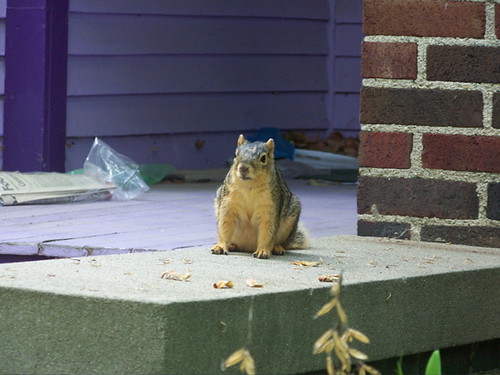
The snack-raficing of squirrels

Where does altruism evolve from? It's a legitimate scientific question, because altruism appears to fly in the face of natural selection.
Why should a ground squirrel give an alarm call at the sight of a hawk, which raises her chances of being eaten by the hawk? She should duck and cover, to save her own skin.

These questions long since puzzled people who study behaviour, since the trait should become rare in the genepool as these self-snack-raficing individuals are digested and turned into parts for baby hawks. In the end, there should be nothing left but the squirrels that get the heck out of dodge.

The beginning of our understanding of apparent altruism among animals came when people began understanding fitness better. The ground squirrel could be a mother, trying to save her offspring. If she can save them easier than she can produce more pups, then she should do that. Putting it mathematically, she should act when

B>C*i

Where B is benefit, C is cost and i is rIsk. In this case, the benefit is past reproductive success - potential grand-offspring to carry her traits into the future. The cost is how much she'll pays - all the future potential offspring she could make. And the rIsk is the probability that she'll have to pay that cost. The cost can be very high, but if the risk is low, you don't need much benefit to justify the action.

W.D. Hamilton  formalized this even better, with Hamilton's rule (imaginatively named) where a trait (such as this self-snack-raficing behaviour) is expected to become more common in a population when the inequality is satisfied:

r*B>C*i

Where r is probability that the recipient of the actor has the trait. From our understanding of Mendelian genetics, this is .5 for parent-offspring, .5 for sibling-sibling pairs, .25 for half-siblings or Grandparent-Grandoffspring. There are some interesting exceptions to these rules that I'll mention in a future post.

So, in plain English, if we define all the future offspring our Ground squirrel can have as being 1,  and assume 100% risk, then the other ground-squirrel she saves should be worth 2 times that many offspring if if the altruistic squirrel is a parent. Along these lines, J.B.S. Haldane was once asked if he'd give his life to save his brother. Jokingly, he replied "Would I lay down my life to save my brother? No, but I would to save two brothers or eight cousins."

Of course, there's far more to altruism than this; we call this principle `kin selection`, where evolutionary impact isn't just from one's own offspring, but from an organism's blood-family members as well. The description of kin selection went a long way to explaining how many forms of altruism we find among animals evolved.

You can find some extreme examples of this in some insects, where queens produce sterile workers. These sterile workers get all their evolutionary fitness from the queen's success, and none through their own reproduction (Because they can't). Because the cost is so low (they'll never have offspring), it doesn't take much benefit to justify extreme actions. In this system, bees with stingers evolve. They die when they use them, but they manage to advance the queen's reproductive fitness just a little more in doing so.

Interestingly, because of bees breeding system, the workers are more related to the female future-queens than the reproductive males. Because of this, the workers siphon off resources from the males larva and invest it in the female larva. There's insurrection in the beehive! 

Tuesday, 27 October 2009

MHC and stinky t-shirts.

I'm going to talk about human behaviour and evolution here. Remember my disclaimer! Don't commit the is-ought fallacy!


Go ahead. Go smell your significant other. I'll wait! Back. Smell good, don't they? Unless they're splitting wood, or something. Even then, I bet they smell better to you than anyone else while splitting wood.

This isn't a coincidence. Human mate choice is governed by quite a bit, and part of the `goal` is to mate disassortatively. That is, you don't want to mate with close relatives. Part of what helps you avoid inbreeding is MHC. Wait, isn't MHC the thing I mentioned earlier to help your immune system? It's the same! It also helps you pick mates. Versatile, eh?

We suspect MHC because of a few experiments. The first, by Wedekind et al. in 1995, had men wear t-shirts for two nights without washing. After that, the t-shirts were sealed in bags, and were presented to a number of women, who were to asked to rate the smells. Wedekind and colleagues collected the questionnaires, and some DNA from both the men and the women, to find out which type of MHC they had. They found that the women rated men with different MHC types as being more pleasant.

People were resistant to this study, because of the long-held wisdom that MHC was for the immune system only. Eventually, the study was replicated in Brazil by Santos et al. (in 2005), except using sweat directly instead. Critics cried that sure, there might be an inclination, but surely other factors weigh out in the final mate choice. Well, we have reason to believe these turn into actual matings - Ober and colleagues analysed marriage patterns in Hutterite  communities and concluded that people tended to marry individuals with different MHC types.

Interestingly, MHC also seems to predict fragrence preference in perfume Milinski and Wedekind found that MHC type predicted the type of fragrance people preferred for themselves. This predictive power didn't hold over to preferences for partner fragrance. But this is, in a way, expected: for self, perfume is advertising one own MHC complement. For others, it doesn't matter what MHC they have, so long as it's different from your own. 

Humans aren't the only critters who tend to marry/mate this way. Mice (Potts et al. 1991) tend to do that, as to Fat-Tailed leamurs (Schwensow et. al 2007), and fish such as Three-spined sticklebacks (Reusch et al 2001). There are many other species that have been studied, and this pattern found - though others where it hasn't. It's important to note the magnitude of the mate selection bias varies among species to levels difficult to detect.

It's worth noting that finding MHC disimilar mates is not a hard thing to do. If this was just to keep offspring MHC diverse, it'd probably be easier to pick an individual at random - they've got a low probability to be MHC similar. All human groups have a large amount of MHC diversity, and it's been well conserved through most human lineages. Truly, the only purpose this could serve is to avoid mating with those similar to ones-self - such as close relations. Today, avoiding inbreeding might seem trivial, but you don't have to go far back in human history to have a situation where two individuals don't know how related they are to eachother, because of incomplete genealogical knowledge. If you're a ground squirrel, life is even harder, knowing who your family is!

But if you're a ground squirrel, how are you reading this blog?

It's interesting to think that this is all going on without our being aware. Aside from some researchers, I don't think anyone out there is thinking, "Gosh, this person is right for me, because their MHC is clearly quite different from mine!" This is all going on inside our nose and brain without us even being aware of it. This is just one of many things we smell, but aren't quite completely aware of - the more we learn, the more it seems we're some of the worst judges of why we do things!

Bonus points to anyone who recognizes the movie clip. :)

Wednesday, 29 April 2009

Your standards may vary.

Danger! Human stuff! Remember my disclaimer! Don't fall for the naturalistic fallacy!

It shouldn't come as a controversial that our behaviour is different in winter. We sleep more, we're less energetic, we've got slightly larger appetites, etc. Previous studies had shown that humans also experience shifts in hormone levels. Do seasonal fluctuations in men's hormone correspond to changes in mate choice?

Two Polish researchers, a place with something that passes for a proper winter, decided to put this question to the test. They showed over a hundred men of varying backgrounds computer-generated pictures of females of varying attractiveness, and had the respondents record scores for various attributes (e.g., `facial attractiveness,` `body shape,` etc.). They repeated this in the summer with the same pictures, and took the same measurements.

They found that in the winter, males tended to rate females as being more attractive than they did the same attributes in the summer. This held true for all attributes except for facial attractiveness, which remained constant between seasons.

The authors, being perception researchers, ascribed a different mechanism to this - They suggest that seasonally, your exposure to body types vary. In the summer, males are exposed to more female bodies than in the winter. Though I'm not sure I agree with their hypothesis, I've an anecdote to illustrate this. I was waiting at ADFG for the winter antlerless permits, like the idiot I was. There were a great number of people in line during that -40 snap we had, and you got to talking to stave off boredom (and to take your mind off the cold we were standing in for hours and hours). I spend quite the while talking to someone named Red (the third Red I've met, not counting people called Kavirliq).

Well, fastforward a bit to when it's only -20°C, and a partner and I were going down a mountain when one of our Snowmachines got stuck. We're trying to get it unstuck, when Red and a few others come down the trail behind us. They graciously help us dig it out of the mess we got stuck on... but I couldn't help but notice that Red wasn't a male, like I'd assumed before. She wasn't wearing all her heavy winter gear, and so you could quite distinctly notice she was a her, albeit a tall "her" with a lower voice, but otherwise unquestionably female. You just couldn't tell before, because all the clothes.

Now this is an extreme example. Most of the time, you interact with people indoors, and they're not wearing carharts, a parka, a face mask, a trapper's hat, musher's mitts and bunnyboots. But humans do tend to wear long sleeves and pants, along with looser fitting garments and bulkier clothes in the winter. This is to contrast with Summer, when it's shorts and T-shirts all around. The authors argue chronic exposure to one setting or the other is what leads to acclimatization, and therefore varying the threshold of `what is attractive.` My own thinking runs more toward seasonal fluctuations of hormone titres, but I've minimal evidence to support this.

Citation:
Perception. 2008;37(7):1079-85.

Men's attraction to women's bodies changes seasonally.
Pawlowski B, Sorokowski P.

Click for Fairbanks, Alaska Forecast