Showing posts with label moose. Show all posts

Wednesday, 11 May 2011

Moose on the loose

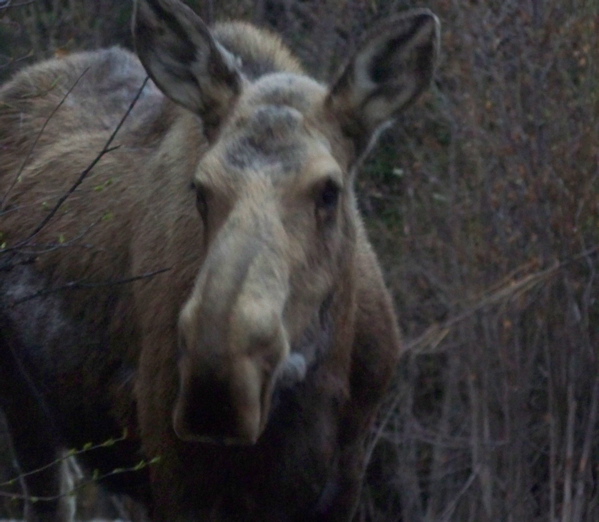
A moose decided to check out UAA's student union. Some suggested captions:
  1. Hey buddy, aren't you a little young to be taking college classes?
  2. More proof the university doesn't really care about the students: there's not even a sprig of willow in any of dining halls! You have to go off campus for some decent food!
  3. UAA decides to hedge their bets against UAF next hockey season by recruiting a new netminder who can simply sit down in front of the goal.
  4. Yes, UAA's admission standards have slipped a little bit. Still, he had an impressive list of extra curriculars.
  5. Yes, I am a bit fuzzy from the lack of sleep. Why do you ask?
  6. A moose looks for biologists to netgun and radio collar. 

This is what you get from me when I'm running caffeine and old episodes of Top Gear in the background while I scramble to get everything done in the next two weeks. What would you caption it with?

[Photo Credit]

Tuesday, 8 March 2011

In the annals of Dim Things To Do.

I've said it before. Heck, I've said it here. Do not pet the moose. You do not share a deep spiritual connection with them. They won't recognize you as a kindred spirit.  They aren't your bestest friend in the world. Some of them may be quite cute, but forget about taking them home with you. It isn't going to end well for either of you.

Even not counting car collisions, a moose is more likely to injure you than a bear or a wolf. People fail to appreciate that even a small moose can weigh 800 pounds, and can kick hard enough to break bones. It's not uncommon for wolf biologists to find that wolves in our area have had their skull fractured seriously at some point because a moose kicked them in the head. And a wolf skull is a lot more robust than a human's skull.

And besides, you probably wouldn't like it if a total stranger (and a different species to boot) came up and started petting you, either. Even moose like their personal space.

Petting a moose is about as dumb as it gets.

Moose-petters: 

Tuesday, 22 February 2011

A little about moose hair

One of the more common questions people ask is why they don't seem more moose hide clothing items around. It's a fair question: moose are large animals with lots of fur, so surely some of that is useful. And even many people who grew up knowing not to use moose fur for anything serious don't know why they shouldn't use it. It's a simple enough answer, though: the hair sheds like crazy. The hair shafts are constantly breaking and shedding over time, meaning very quickly you'll lose some of your best guard hairs, and be left with little warmth. You can tan moose hide, but the only thing I've ever seen it used for is the de-haired leather.

The reason moose hair sheds so much is that the hairs themselves, like hair of all deer, are hollow. They almost look like someone's blown bubbles into the middle of the shaft. I'd love to post a picture of it right here, but I don't have one that I have rights to. But I can link to this picture here on another website. That beautifully shows the inside of a red deer (aka, elk) hair shaft. Most deer (including Caribou, moose, and so on) have hollow hair; most thinking is that this is a trait to help them thermoregulate, or maintain a consistent body temperature. The hollow shafts provide additional dead air space to keep a pocket of air warmed (or cooled) to their body temperature. I haven't seen this idea rigorously tested, though.

Monday, 1 November 2010

Isle Royal Lessons: Predation Risk v. Dinner

ResearchBlogging.orgIt's been a while since I've written a science blog post, and not because I haven't been reading papers. On the contrary, I've had the exact opposite problem! I'd like to revisit some work done on moose on Isle Royal, Michigan, one of the best studied ecosystems in the US. Reading about the Isle Royal studies was part of what got me into biology to begin with.

Isle Royal is an island in Lake Superior, north of the tip of the Upper peninsula, and not far from the coast of Canada. It's around 70x15 km in size, and almost all of it is encompassed in Isle Royale National Park. The island is the result of geologic tilting, which results in long ridges and islets that all run in the same north-east sort of direction. It's a wonderfully beautiful area,  and the site of much study between wolves and moose. There used to be caribou there as well, but they were expatriated. I would love to see them reintroduced there, but I'm a tad biased towards Caribou, aren't I?

Joan Edwards, now at Williams Collage, did regular surveys of the location of moose sightings. They patrolled moose trails, and did coastal surveys using a boat, and recording whether it was a bull, cow, whether it was alone, whether it had a calf, and so forth. Additionally, she surveyed the diet through observation, recording bouts greater than 10 minutes.

What she'd found is that there were quite the change in locations between cows with calves and all other moose. Bulls and cows without calves tended  towards the ridges on the main island for the beginning of the growing season, before meandering their way towards the shoreline and the aforementioned small islets in July-Sept. This is to contrast with cows with calves, whom were very strongly associated with shoreline, or islets, from May through the remainder of the season. Moreover, they showed that the cows with calves had a very poor quality diet when compared to those without. I've reproduced a figure showing their distribution in various seasons, and you can really see that the cows with calves really had a strong association with those non-interior sites.

Now cow moose have a large investment in calves. It's not the pregnancy so much, but the lactation afterwards that really kicks them in their behinds. Whereas a male's fitness tends to come from its ability to cover multiple females, a females fitness comes from its ability to successfully bring the offspring to independence. Thus, a male is limited by its ability to snarf down forage and become large enough to be dominant, and a female is limited by her ability to trade off predation risk and her basic needs in terms of body condition. Additionally, you could infer that the variance in reproductive success in bulls (either they have a ton of success, or very very little) would lead them to very different risk-benefit calculations as to whether they want to eat in food-rich but predator heavy areas. 

Put into this context, Joan Edwards' research makes quite a bit of sense. Each class appears to be trying to maximize their fitness. She throws out Calves are likely to imitate their mothers as an alternate explanation, but I think she's right to dismiss this alternative fairly easily, since they could just as easily find the same assemblage of forage elsewhere, and at greater quantities. Addationally, I haven't seen the behavioural patterning work go very far with moose, and it's quite possible that that hypothesis petered out in the intervening decades.

However, I do have some general criticisms. First, the study is dependant on sightings, but I saw no estimation of sightability. Supposedly the long duration of observation could rectify that, but in such a dense, closed forest, opportunities for missing animals are rife. Secondly, the sightings could have been systematically biased by one of two ways. First, the lowest predation risk areas for cows with calves on the mainland could have been the hardest to get to, due to terrain, vegetation cover, and other factors. Human bias in these studies can be sizeable, as no one likes to hang around in a hard to reach boggy area looking for moose. Secondly, the mere act of moving about could have scared the cows with calves off in the mainland, because of their heightened concern as to predators. Really, the way to do this sort of study the best would be through radio telemetry, aka collaring and fallering. All that said, I think the effect is generally a real one, albeit not as strong as Dr Edwards suggests.

Edwards, J. (1983). Diet shifts in moose due to predator avoidance Oecologia, 60 (2), 185-189 DOI: 10.1007/BF00379520

Sunday, 12 September 2010

*Tap Tap* Is this thing on?

Hello!

You might have noticed I've been absent for a little bit again. I was out in the field again, wrapping up the season with some various and sundry work. I've run into a tiny snag in my personal life, and although I'll try to have some posts out, it'll definitely be fewer and longer between posts until everything is peachy again.

In the interim, here's a moose staring at you.

Thursday, 24 June 2010

Moose management - it works, sometimes

ResearchBlogging.orgWell, I finished reading "Science and Values Influencing Predator Control for Alaska Moose." It was actually a very good read, with excellent cadence, even if I had heard all of this at conferences before. I've got a few general comments on this, but first I'll lay out the review a bit.

It comes in four five.
First, it reviews the relative effects of predation to other factors for moose. After all, if it's mostly nutrition limiting moose, additional rounds of predator control will not bolster moose populations, or will only do so slightly. Their arguments are old-hat to anyone who's been on this ride for a while, but it's worth repeating:
  • Most moose in AK are at low density.
  • Moose at low density are primarily limited by predation.
  • Moose in some areas experience effects from high density.
  • Moose in high density areas are not very effected by predation.
  • Everyone is effected by random "bad winters" (Winterkill).
  • Most moose predation mortality is in juvenile moose.
The second section dealt with manipulative studies - that is to say, our previous experience with Intensive Management. Here there's eight cases laid out that I won't go into exhaustive detail on. The best evidence, by far, is GMU 20A, or the moose south of the Tanana river and north of the Alaska Range. McGrath has potential to be a more important finding, but as of yet it is a weak-moderate finding. I am very unconvinced by data from 20D, but others might consider the data from that unit good. In general, the pattern of predator manipulation (which wasn't always IM) was followed by improved moose censuses. Some of these have thus-far been sustained (20A), others less so (Kenai).

The third, and shortest section, is on sustainability of the increases moose counts. This is the shortest section, since the data is the newest (or in other cases, the weakest). Again, the best data comes from Unit 20A, where there's been a sort of accidental experiment going for a while now. Important factors in the long term-sustainability of these populations seems to be a) carefully monitoring nutritional status b) doing habitat improvement when possible (this includes allowing burns to proceed, or doing controlled burns) c) allowing larger cow moose hunts to keep the population short of carrying capacity (overshooting K is a Bad Thing™).

Next comes the sustainability of wolf and bear populations in interior AK. The evidence for sustainability is very firm, and although I'm sure some people could twist it, in general most people can recognize that the situation is fine. The areas involved are vast, getting people involved in bear harvest is actually very hard, wolves and wolves do an exceptionally good job compensating for high harvest, and IM areas only seem large until you consider how big the state is, and how many and how large non-IM areas are. This is the section from my earlier quote. 

Lastly, there are some general comments on the sociology and public opinions around IM. It discusses logical fallacies employed by both people for and against it, and seems to suggest reconciliation is unlikely because either user group starts with fundamentally different premises and values. I think this is an overly grim view of the situation, and have hope that open communication can bring the public to some sort of consensus. This section had  a great table which I'll repost here.

In general, the message is that "Intensive Management Works*" Where there's a footnote that would read "*Under some models, in some conditions, some of the time." Which I think most biologists would be willing to concede. A large part of the problem over IM is the perception of conflicting values, which is an inherently non-scientific issue. I know that some Scientists would reply that the HD equilibrium is inherently unstable, and it's the LD "dynamic" equilibrium that's the most stable state. I'm not sure there is good ways to argue for or against that right now, without, say, 20 more years of data that doesn't exist.


Okay, here's my thoughts, in no particular order:
Caribou are generally a less-reliable prey than moose because seasonal distribution is more clumped and unpredictable, and voids exist in caribou distribution in inland Alaska.
I agree with the latter part of the sentence, but the former really needs a citation. I can't just let that pass. Where caribou are abundant, they have the potential to be a substantial part of wolf diets, potentially lowering the number of moose. I can illustrate this with a model, but I don't have data to back this up. However, neither do they.


It seems like Winterkill is often ignored as a major factor moose population trajectories. And it's hard to react to stochastic severe winter events fast enough to change management. This is the biggest lesson I take from the Fairbanks winter of 1971 (though I take others as well). We need a better manner of accommodating severe winter events.


Given the invasion of White Tailed and Mule Deer from the Deep South™, should our management objectives change from managing for high density populations to managing for low density? LD populations have two big advantages - first, contact between moose is lower, so disease transmission is reduced. Second, moose are in better nutritional status, which correlates strongly with the ability to mount immune responses to the emerging diseases. On the other hand, LD moose populations have declining recruitment as population declines due to diseases, whereas in HD moose populations, recruitment increases.  I don't know the answer to this question. Science is needed, because CWD and Winter Tick are coming to AK whether we like it or not.


IM for bears could probably be highly refined. Bears are even more cultural than wolves are, and in one instance less than 50% of killed 72% of calves. You could probably get away with just removing, or killing, the better predators. I think we need to start viewing bears as people long-ago did - as human in their cognition. But I'm a big proponent of the idea that bears show strong cultural evolution, so take that with a grain of salt.

Boertje, R., Keech, M., & Paragi, T. (2010). Science and Values Influencing Predator Control for Alaska Moose Management Journal of Wildlife Management, 74 (5), 917-928 DOI: 10.2193/2009-261

Tuesday, 1 June 2010

Baby moose!

If you love pictures of cute fuzzy things, check out the ADN gallery of Baby Moose.

In general, moose-human incidents spike this time of year, as momma moose do what one of my Air Force friends calls "Monkey Stomp the Crap out of people." This is not technically true, as they moose stomp people, not monkey stomp. Thus, moose calves are best enjoyed from a safe distance, on the other side of a wall, or via internet pictures from photographers brave enough to take pictures. :p

Monday, 5 April 2010

Beware the moose!

It's about that time, when people are getting into trouble with our state's bigger residents (and I don't mean people who watch too much TV!). Around this time of year, cow moose are deadly, and more people have problems with moose than bears. And on the Kenai, they're already having problems! Usually we have to wait until mid-may for this kind of excitement!
ANCHORAGE, Alaska - Alaska Wildlife Troopers rescued two Ohio men after the pair interrupted a life-or-death struggle between a moose and a wolf.

Sean Evans, 31, of Toronto, Ohio, and his cousin, Josh Clark, 30, of Scio, were snowshoeing out to a cabin on the Kenai Peninsula south of Anchorage on Thursday when they rounded a bend in the trail, ducked under a fallen tree and saw the spectacle crashing toward them from about 20 feet away.

"The wolf had torn off some skin from the moose's neck and was hanging on its neck," Clark told the Anchorage Daily News. "We kind of looked at each other for three seconds and decided to start moving."

The wolf took off when it saw the pair, but the moose charged them. They dropped their packs. Clark climbed a birch tree while his cousin got behind the fallen log.

They couldn't spook the moose, even when they yelled and threw things at it, he said.

"Anytime one of us moved, it kind of charged and paused," Clark said. "I was in the tree. I didn't care. So anytime (Evans) would start making noises, I would try to sort of distract it, because I felt pretty safe."
I wonder if it was a cow who just had her calf eaten? It's not uncommon for a nearly-yearling to still be around a cow this time of year...
"They were totally blocked. The moose isn't going anywhere," Acton said. "They'd been hiking and snowshoeing in, so they didn't have all of their cold-weather gear on because of perspiration and all that, and now one's been up in the tree for four hours. I mean, he was visibly shaking, I think not only from adrenaline but from the elements as well."

For the men's safety, troopers decided to kill the moose.
Too bad. Still, not much else you can do in that situation.

Wednesday, 24 March 2010

Shock!

I'm shocked! The internets have failed me! Well, not really. You all were right about the species - it's a moose part. (Though, it should be no shock that I have pictures of moose and caribou parts). But it's a moose toe. These are moose phalanges. I guess it's not as easy as I thought! Or, it's not as easy as it is for someone who spends too much time thinking about game. >.>

Thursday, 25 February 2010

White-Tailed deer and asymmetry

In general, we expect fluctuating asymmetry to be a sexually selected trait. How's that for an opening line? But it's generally true: Females prefer males that are more symmetric. We find that in humans, mice, rats, and about a dozen other things, so the finding is fairly robust. In fact, you can experimentally alter faces' symmetry using computers, increasing it or decreasing it artificially, and ask people to rank them. People are pretty consistent in their rankings, across cultures. 

Why? Why do animals prefer more symmetric animals? Well, there's a slew of hypotheses. Most of them revolve around the fact that the random deviations from symmetry (that's where the 'fluctuating asymmetry' term comes from) tend to be linked with past stress. It could be it was a sick child. Or a poorly fed child. Or in development, they got into problems with predators, or other sources of injury. Or it could have been environmental toxic exposure. Whatever the cause, the response tends to be pretty straight forward: do not want.

If a mouse was very sick as a pup, that means that a choosy mouse doesn't want him. After all, it might have STDs. Or it could have bad genes, that predispose it to sickness. Or it lacked behaviour that kept it away from infection. Either way, a choosy mouse doesn't want any diseases itself, and it definitely doesn't want bad genes for its offspring. No thank you! If it wasn't fed much as a pup, well, its mother gave its food finding skills/knowledge/genes, and you don't want those either. That, is, in a nutshell, fluctuating asymmetry. Or, as the cool kids call it, "Flucing A." Serious. Scientists say that with a straight face.

Weidros.

Most fluctuating asymmetry comes from early/juvinile development, because that's when most of the development occurs. But traits like antlers pose an interesting extension, because they're produced fresh each year. In theory, each new set of antlers is a demonstration of how the bull's life has gone up to that point, not just up until it reached adulthood. That's multiple points to demonstrate fluctuating asymmetry. If a male had a bad year, that information will be integrated into its antlers the next season. And antlers are some of the fastest growing tissues, so they easily react to stress to induce fluctuating asymmetry. They're also sexually selected traits, in that antlers mostly exist to woo the ladies, or intimidate other males.

In general, we expect the following pattern: Older males, less fluctuating asymmetry. That's because if you've lived a while a) you're good at what you're doing (and the worse ones have died off a bit) and b) you're more socially dominant. Also, we generally expect larger antlers to have lower fluctuating asymmetry, because only good males can make big antlers. Previous studies have found positive relationship between symmetry and low of parasite load, while others have found vague support for fluctuating asymmetry and antler size.

But here's the thing. Those were with 2-d measurements. Highly asymmetric antlers could numerically be recorded as symmetric because the data can't distinguish symmetry.

Well, Stephen Ditchkoff and Rachel L DeFreese decided to correct that. In their paper, "Assessing fluctuating asymmetry of white-tailed deer antlers in a three-dimensional context," (DOI: 10.1644/09-MAMM-A-134R.1.), they used 3-dimentional modelling to find out if a) Antler Size is negatively correlated with fluctuating asymmetry and b) age is negatively correlated with fluctuating asymmetry.

What was their sample size? What was the nutritional status of the deer? What was the sample site? All these I can't answer in any detail, because frankly, the descriptions in the paper were wanting. They mention two counties in Alabama  in 2002-2003 hunting season... well heck, that means nothing to me. In such an environmentally induced trait, population location, and position with respect to carrying capacity (K) matters. I'm going to assume that these were good years, in apex populations. But how many samples? I don't see it spelt out clearly. I think it's 121, because that's the largest n they have on any of their measurements. Still, I'm unhappy with that. I normally enjoy Ditchkoff papers, so this was bum.

But, when all is said and done, they tested their two hypotheses, and reject both of them. Age is at best weakly correlated (r≤0.33) without be statistically significant (P≥0.083). Further, there wasn't any consistent link between age and decreased fluctuating asymmetry. The stats on this are messy, and the tables numerous. But the take home message I think is sound.

So, WTF? I tell you all about fluctuating asymmetry, and then I tell you it's bunk? Well, I wouldn't say that. I don't think age is a big role in fluctuating asymmetry, because of Bowyer, one of our ex-faculty, who did some work in moose.  I've attached some graphs that show that males increase over age, before petering out at the end. Really old bulls then enter decline, when their antlers go to heck. I wanted a picture of clubbed antlers, but I don't have one handy - shame. So that would erode the relationship between age and fluctuating asymmetry. Antler size is a bit more troublesome... and I think the authors were on to something when they offered the hypothesis that maybe things weren't severe enough to produce patters.

Given antlers tend to hit a max with age, most bull moose (or buck deer, in this case) will have roughly the same size, within a normal distribution. When you really see a lopsided distribution (gamma) is when times are tough, and there's one shining winner, and a whole lot of losers who aren't looking so pretty any more. This is why ecological information is important in fluctuating asymmetry papers. I need to know how much the animals are getting pushed, because it's when the things get bad you know who's worth his salt.

Tuesday, 26 January 2010

Abstracts: The function of contrasting pelage markings in artiodactyls


The function of contrasting pelage markings in artiodactyls Behav. Ecol. Caro and Stankowich 21: 78  DOI:10.1093/beheco/arp165

Comparative studies of pelage coloration in mammals suggest that certain prominent markings on an otherwise uniform pelage background serve in communication. We matched the position and coloration of contrasting markings on the bodies of all even-toed ungulates to ecological and social variables in order to ask whether marks are used in communication generally, as a signal to predators, or as a signal to conspecifics. Controlling for phylogeny, we found that many marks are located in prominent visible positions on the body; that flank marks seem to amplify stotting and leaping, which are pursuit deterrent signals; and that front leg marks may amplify foot stamping, an antipredator signal. We found that upper leg markings, particularly markings on the podials, are associated with group living hinting at an intraspecific communicatory function. Surprisingly, we found that contrasting marks do not reliably indicate position of scent glands across this taxon and that many white marks may have a cryptic function. These results extend and contradict those of previous analyses and force us to conclude that contrasting pelage marks have a number of functions in this taxon including pursuit deterrence, intraspecific signaling, and possibly even crypsis

Generally, research has focused on conspicuous markings on artiodactyls (artiodactyls with an even number of toes) as being intraspecific signals - that is, between one Roe deer and another, or a Moose and more different Moose. The figure I posted came from Ecology and Management of North American Moose, where they repeat the line about within-species signalling.  The idea of interspecific signalling - say a signal from a moose to a wolf - is very interesting. It's pretty clear that that pelage markings in deer is more complex than purely sexual signalling.

Friday, 22 January 2010

Things Alaskans like: Hunting Moose

Things Alaskans Like is my serial  attempt to itemize all the things Alaskans like. This will serve as a guide for non Alaskans to pretend to be an Alaskan, or make Alaskan friends. All Alaskans like things that Alaskans like.


One thing people tend to underestimate is how much Alaskans like hunting moose. Alaskans really, really like to hunt moose. If you meet an Alaskan, try talking about hunting moose. Even people who don't have moose want to hunt moose. Many people on the north slope look forward to having many moose, thanks to global warming, so they can hunt them too.

If you are new to Alaska, you cannot hunt moose for a year. Instead, try talking about having hunted moose in the states. Alaskans do not recognize how hunting works in the states, and will believe just about anything you say about it.

Hunting moose is generally recognized as a good excuse for missing work, school, jury duty, weddings, funerals, and birthdays. Some clever Alaskans combine hunting moose with weddings, or in some rare cases, funerals. Therefore, no one has to miss hunting moose.

Causing an Alaskan to miss hunting moose is considered cause for starting a fight. Causing an Alaskan to miss hunting moose also a reasonable excuse for quitting one's job, remaining unemployed, or getting a divorce. In general, Alaska judges award all assets to the party who was forced to miss hunting moose, in a divorce. This may not be enshrined in Alaskan law, however. But it is generally recognized as fair.

Do not dress up as a moose when other Alaskans are hunting moose.

Monday, 14 September 2009

Predator Control by Press Release

If I was doing science by press release* to try and convince people everything was great about Predator Control, I don't think I would have taken the tack used in the AP story that the News Miner and the ADN picked up. This story is rife with problems.

First, while it's true that the current program really got started by Murkowski, there has been active predator control of one sort or another since pre-statehood. Poison, bounties and aerial shooting was employed by government agent until statehood. Aerial shooting continued with the public until 1972, when the federal Airborne Hunting Act was passed. This coincided with several harsh winters in the state, resulting in heavy predator depression of game populations.

In 1975, the first wolf control was authorized in game management unit 20A, which is south of the Tanana river from Fairbanks. This was conducted by only ADF&G staff. The policies were shaped over time through the 80s, and in 1992, the Board of Game (BOG) added control to three areas. Due to massive backlash from tourists, Hickel reconsider and BOG revoked their plan. In 1993, BOG authorizes additional predator control for 20A. Predator controlled continued until Knowles became Governor, and suspended all programs.

Because of the long history, I don't think it's fair to say Murkowski is responsible for predator control. It would be like saying I started the tradition of having breakfast this morning. Sure, it's technically true, because there was a gap of about 24 hours where I had no breakfast tradition, but it ignores all the breakfast I've had other days.

My next big complaint about the story has to do with mis-leading verbiage. The story implies that of all areas of predator control, a few have been successful. It then cites McGrath, and the Southern Alaska Peninsula. If we're allowed to talk about predator control as a holistic idea, a better example would be the aforementioned GMU 20A. The area currently hosts some of the largest populations of moose in the state, and very healthy populations of wolves (though not the healthiest, due to the 2003 invasion of a depeliating parasite).

If we're only talking about current areas, then I have some complaints. First, it's too early to be talking about successes. You only know whether you were successful after you remove predator control. One of two things will happen. Either population levels will remain stable, or the population of game species will decline again. If the number of game animals declines again, you know you've mis-characterized the ecological situation, and you're attempting to apply predator control where it doesn't work; if they remain stable, you know that you've been successful**. I will admit, if you don't see an increase in game numbers, it is fairly indicative that your current predator control regime is not applicable.

If we're limited to current predator control areas, then the Southern Alaskan Peninsula Caribou Herd is not great example of anything, right now. The situation is complex, and it's my studied opinion that we're not entirely in possession of all the facts in that system.  While Calf Mortality is clearly a major issue with the SAPCH (<2 per 100 is a very low number indeed), I'm yet to be fully confident that there are not other, conflating factors involved in the long term population trends.

The AP left out something re: the non-resident hunter situation that I think ADF&G would have pushed strong for inclusion. That is, that non-resident hunters are a substantial economic factor, especially in small villages. In order to access the non-resident permitted areas, a guide is typically required. Further, non-resident hunting parties can spend several thousands of dollars per person, and each tag typically results in multiple hunters in a party. While the Nelchina is a complex situation, one that I swore I wouldn't touch with a 10 foot stick, game there is not so precariously positioned that those permits need to be cancelled.

One thing I wish people understood is that Predator Control is like science in general: It's really, really complex. There are no simple answers to pretty much anything; everything is wrapped up in assumptions that need met, confidence intervals, and highly situational knowledge. There should be an * beside pretty much every simple line inside these sorts of articles saying "Well, X is true 85% of the time, and the other 15% of the time, Y and Z are true." We're letting ourselves get trapped by these simple story explanations which don't even begin to cover the truth.


*Science by press release is a pejorative comment to describe non-peer reviewed science that's pushed out there by Public Offices of Agencies and Universities. the chief complaint is that science by press release is rarely accurate, and never goes through the rigour of peer review.


** This is seriously simplified, moreso than everything else here. But the nut of the matter is sound - you don't know, until it's over.

Tuesday, 8 September 2009

Fennoscandian moose revisited

On Thursday, there was a story in the Daily Minor News that was awfully familiar...


FAIRBANKS — In Sweden, a country that is approximately one-fifth the size of Alaska, hunters kill about 80,000 moose per year, give or take a few thousand.
In Norway, which is slightly smaller than Sweden, the average annual moose harvest is 35,000.
In Alaska, hunters are lucky if they kill 7,000 moose per year.

Regular readers might remember that I wrote a short little post on this back in May. Is the News Miner hitting up blogs for their stories? ;)

Friday, 28 August 2009

Tips on catching a moose

Well, Moose Season is upon us, and it's about this time of year that Wildlife Biologists go from those jerks who don't know nothing about nothing to the Hunter's very-very bestest buddy in the world (hey let me buy you a beer) and informational goldmine. What's funny is those jerks who both think you know absolutely nothing about wildlife and wildlife management, but simultaneously want animal information from you. Either I'm a know-nothing-Nazi, or I'm a brilliant Animal guy, pick one people! ;)

Well, I'm not going to tell you where you can find that 60 inch bull, but I can give you some general pointers on things you can do to improve your chances of catching a moose.

  • DO YOUR HOMEWORK
Scout areas first. Talk to people who live around an area, if there are any. Do it before the season starts. If you're flying in, that's a little trickier, but you can still take regular stops on your raft trip/whatever and get on some big bluffs to scope the area out.

  • "DON'T HUNT WHERE THEY AIN'T"
Not my quote, but it's prefect. Remember that Moose are like us, in that they prefer some habitat more than others. Where I might prefer tundra patches to alpine shale, a moose seem to like whitespruce, and are found in associate with water. There are some moose on hilly surfaces around here this time of year, but in general they prefer flats. In the Rocky Mountains, the trend is totally reverse.

  • GET OFF THE *****ing ROAD!
Studies have shown that the further you get from the road, the more you travel, the more likely you are to catch that moose. People who road hunt have a low level of success. People who walk in on foot have a higher level of success. People who take a boat or ATV have a higher level of success. People who take guided fly-in hunts have a very high level of success. In general, the deeper you're able to access, the greater your odds are.

Alternatively...

  • LEARN TO USE A BOW
The Fairbanks Management area has many legal bulls in various and sundry places. you can catch them, and they'll all but fall into your freezer. But there's a massive catch - you must catch them with Archery only. For this reason, many people are unwilling or unable to engage on these hunts. If you look at the regs, many of the Fairbanks Management area hunts are very liberalized (i.e., no antler requirement for bulls), but there's still difficulty in controlling in-town moose numbers. Many that aren't harvested here end up as road kill. That's good for no one.

  • JUST HOP THE RIVER
Unit 20A is some of the most productive moose habitat in North America. To find something comparable, we have to go overseas in Fennoscandia, which is practically a moose factory. However, many people are unwilling or unable to hunt in 20A. Consider getting help using a boat, or renting one. As far as rifled hunts go, the hunt in 20A is one of the best.

  • DON'T KAMIKAZE
Kamikaze hunting is where you go out and hunt really hard for a few days (usually a weekend) and then have a hard return-date. It's short, intense, and it inspires people to take stupid risks. Take your time. If you're not rushed, you won't practically walk over moose because you'll be able to stop and look around. In general, the more time you allocate to a hunt, the more likely that hunt is to be successful. In the Interior, here in Alaska, "I was out hunting moose" is often a legitimate work excuse.


I hope this helps. I won't be going out this year, since I have no freezer space after my last fishing trip. I actually prefer it that way - I can go do a winter hunt at my leisure, since I've got meat to last me a while. But I wish all of you the best as the various hunts open up.

Remember to sight in your rifle!

Monday, 11 May 2009

Sudden moose

As I sit here writing this, it's 10:10p on Sunday. Just a few minutes ago, I was typing away some stuff, watching a bit of TV, when I glanced over and noticed there was a moose about 4 feet from my head. It was on the other side of the window, but still, it was a bit of a shock to see this in your face:
Right now, I have a perfect lung shot. It's a cow, too. I do love cow. Young one, to boot. Alas, poaching is bad, so I'll just look and covet. You know, in another life, it would have been a crime not to catch it.

What is it the French say? C'est la vie.

Click for Fairbanks, Alaska Forecast