
Showing posts with label critters. Show all posts
Showing posts with label critters. Show all posts
Wednesday, 6 April 2011

Thursday, 27 January 2011
Sometimes, it does matter where you're from.

One of the major thrusts of the research I've involved with in the last few years is in the world of "domestic introgression." Some times, when we move animals around, there will be a pre-existing wild form of that species. For reindeer transplanted to Alaska, it's the endemic caribou. Some mink farms are in areas that already have a wild mink population. And a dog is nothing, if not a very funny looking, strangely behaving wolf. The concern is often that our tame species - the domestic species - will breed with the native wildlife, introducing genes that have more to do with living with humans than in the wild. That's what we call introgression - broadly speaking, it's when genes from a species or subspecies sneak into a new species. In many cases, natural selection can do its thing and purge these genes, but with the right conditions, even these very poorly-adapted traits do filter in to the wild population.
Red foxes have been extensively bred for farm fur, not unlike mink. The sort that have ended up in these farms are a total hodgepodge of various foxes bred together for the best fur characteristics, while still being tame. You might remember the tame, Russian foxes I talked about earlier, with their collie like appearance and their cheery disposition. Some foxes escaped in Californian fur farms in the mid-1900s, where they established a growing invasive population in the Sacramento Valley over the ensuing time. From here, they've come into contact with the native foxes - foxes that have long been there, and are well adapted to the local environment.
Enter Benjamin Sacks and colleagues, working out of the University of California, Davis. They took DNA from foxes throughout the Sacramento Valley, and looked at a variety of markers - some mitochondrial, some microsats, and some SNPs. In addition to the typical analyses (For HWE, Linkage, and so on), they assessed whether there were domestic introgression into the wild foxes using STRUCTURE (a package that assigns individuals to populations when you don't know the number or placement of the clusters) and BayesAss, which assigns individuals to populations based on prior knowledge of the populations. Finally, they used Migrate-N to assess how much the geneflow there was between the domestic foxes and the native foxes.

From the traditional stats, they had a microsat HE of 0.65 and 0.69 - something I would think is low given an average number of 6.1 and 6.6 alleles per locus. They didn't have any HWE issues. Additionally, it was clear that the wild and the introduced groups of foxes assorted with themselves spatially - that is, there was a region of native fox, and a region of introduced fox, and not the two intermixed in the same area. You can check out the figure to the right to get the general feel for the lay out - the caption has a lot of useful information in reading it.
When they looked at information about potential migrants, and admixture, they found a small number of individuals who didn't match either the 'native' or the 'introduced' groups that they resided within. When they looked at the mitochondrial DNA with the nuclear DNA, it was clear that all of them were of clear hybrid origin - not migrants, but the first generation cross between a migrant and the local group of fox. However, the authors also argue that there's a region of individuals who are primarily of hybrid origin. Finally, the analysis of Migrate-N showed a generally low level of introgression between the groups, of about 1.31 and 0.91 effective migrants per-generation.
Taken together, Benjamin Sacks and colleagues argue that there is some sort of selection preventing the groups from intermixing. Something about the inherent ecology of the wild or domestic foxes (or both) is preventing too much of the domestic genes from bleeding into the native foxes, and vice versa. They suggest that the hybrids they do find are due to a low density area, and but that the mating system of red foxes makes it difficult for introduced foxes to interbreed with the native foxes. I remain somewhat skeptical of this argument, and I'd like to see some experimental evidence to back the claim.
The study was generally well done, but I do have a few general critiques. The sample size from their "hybrid zone" is very low indeed. I would really prefer to see additional data from there, to actually elucidate the strength (or lack there of) of the hybridization. Getting samples isn't always easy, but drawing inferences about those regions on the basis of n=3 and n=3 seems perilous to me. I'd like to see a better treatment of hybridization using BayesAss. Ideally, there should be 'reference' populations to check against. I recognize this isn't available for one or both groups sometimes (oh, what I wouldn't give for reference populations in some of my own work), but results must then be interpreted in light of the lack of reference populations. There could be previous introgression that we don't see, because it's gone to fixation in one or both groups. It is unlikely that this has happened here, given the high Fst and that hybrids seem to be selected against, but it's something I keep in the back of my mind.
SACKS, B., MOORE, M., STATHAM, M., & WITTMER, H. (2011). A restricted hybrid zone between native and introduced red fox (Vulpes vulpes) populations suggests reproductive barriers and competitive exclusion Molecular Ecology, 20 (2), 326-341 DOI: 10.1111/j.1365-294X.2010.04943.x
Figure reproduced from the above cited publication under a fair-use rationale.
Thursday, 23 December 2010
Thwarted!
If you don't work with them, you'll be thwarted at all turns in your quest to pet a muskox. At the farm and at LARS, you're not allowed to pet them (for obvious reasons), and even once one's dead...

There's no winning!

There's no winning!
Thursday, 21 October 2010
Egg eating Snakes
While I'm 'nomming' my lunch (As the cool kids say), I was reading about this interesting group of critters. See, I learnt a rule in college that says you should never eat anything bigger than your head. Clearly, these egg eating snakes have never heard of this rule.
You can read more about them over at Jerry Coyne's blog, WEIT. While mammals have a reasonably diverse group of modes of feeding, I can't think of anything as outlandish as this in the species I study. No one who owns a dog will be impressed by how fast a wolf can eat, and moose and caribou have comparatively boring feeding ecology. It's days like this I'm envious of other scientists for working on really crazy weird critters. :P
You can read more about them over at Jerry Coyne's blog, WEIT. While mammals have a reasonably diverse group of modes of feeding, I can't think of anything as outlandish as this in the species I study. No one who owns a dog will be impressed by how fast a wolf can eat, and moose and caribou have comparatively boring feeding ecology. It's days like this I'm envious of other scientists for working on really crazy weird critters. :P
Wednesday, 14 July 2010
Computer blahs
I'd love to hammer out a few more posts, but my computer is developing new broken parts all the time. The latest one is the power supply - I shouldn't be shocked, I suppose. This is a 4 year old computer! Here's two things to keep your attention for a few
Kangaroos fighting!
Apparently, I write like this guy:

Kangaroos fighting!
Apparently, I write like this guy:
I write like
David Foster Wallace
David Foster Wallace
I Write Like by Mémoires, Mac journal software. Analyze your writing!
Monday, 7 June 2010
The island of Drunk Monkeys
This is too cute to not pass on. It's a clip from a BBC documentary, that talks about St. Kitt Island, where some primates have a booze problem, and it's not the Humans...
I think the cool kids would call everything the monkeys are doing at the end a "Party Foul." Which is not to be confused with a Party Fowl.
I think the cool kids would call everything the monkeys are doing at the end a "Party Foul." Which is not to be confused with a Party Fowl.
Thursday, 27 May 2010

Monday, 10 May 2010
Random things
It's true. I basically follow any instructions I get blindly. Well, I don't keep my photos organized in such a way to make it easy for me to go to the eight folder, but in keeping with the spirit of things, I opened 2008, went to the 8th roll, and opened the eighth picture. And it was my most fearsome nemesis: TIREEATER
 Tire-eater ate tires. She wasn't very big, but she had a huge apatite for rubber. Or, more accurately, the salt on my tires. You see, I'm told that when alders and willows get stressed, they put out secondary compounds to poison the Snow Shoe Hares. However, the hares have evolved the ability to detoxify the compounds. However, the process requires huge amounts of salt - I'm not sure if they need Sodium, Chloride, Potassium, or what. Tire-Eater got her salt from chewing on my tires. Tires are $($(*$ing expensive. But what could I do? I couldn't shoot her - not that I didn't want to, but I would shoot my truck in the process! She wouldn't come in the same direction twice, and so snaring her wasn't an option. And it wasn't winter, so I couldn't trick her into using a snared path.
It turns out the solution was to attract some foxes to my area. >:)

Problem solved!

It turns out the solution was to attract some foxes to my area. >:)

Problem solved!
Thursday, 6 May 2010
Bevers! In! Spaaaaaaace!
I love beavers. They're neat animals, they taste nice, have nice fur, and are fun to watch alive too! And I'm awe of this particularlly industrious beaver This is, in fact, the world's largest beaver dam. It's so large, it can be seen from space. Wow!
And to think I felt really good about building my boat. I think Alaskan beavers are getting laaaaazy, if Canadian beavers are the current record holder. We cannot allow a beaver dam gap!

[...] One such place is found in a lush, remote corner of Wood Buffalo National Park, tucked at the base of Alberta's Birch Mountains. There, generations of beavers have laboured for decades on an 850-metre-long dam that is longer than eight football fields stretched end-to-end, or one and a half times the height of the CN Tower.
The beavers of Wood Buffalo have worked for at least 35 years to build the dam, which means it has already taken 15 years longer to build than the Taj Mahal, one of the seven wonders of the world.
And to think I felt really good about building my boat. I think Alaskan beavers are getting laaaaazy, if Canadian beavers are the current record holder. We cannot allow a beaver dam gap!
This is very good, because it shows how much animals reshape their environments. Besides beavers, bison create wallows on a large scale, caribou differentially impact the tundra, and wolves control where ungulates hang out. There are plenty of ways animals reshape their environment, we're just not used to thinking about it.
Monday, 1 March 2010
Repost: Beavers and monogamy.
Things are busybusybusy. I'm going to phone it in today. How about a blast from the past: Beaver monogamy!
 About two years ago, I decided I would destroy monogamy. That's right, I'm one of those people who are out to wreck family values that the `Focus on the Family` bunch warn us all about. Except I deal mostly with animals, so I suppose I'm who `Focus on the Family Castor Chapter` warned us all about.
See, I, in 2005-06, I first began wondering about beavers - no, not that sort. Perverts. Though, I suppose I could write off a lot of things as business expenditures if I was researching them. (I'm done with the bawdy jokes now, honestly). See, the issue with beavers is that they're stereotyped as good old, monogamous, happy family critter. And it's been my experience that when we think that's so, it simply ain't so bob.
For example, for the longest, we assumed a number of species were monogamous. Take Swift Foxes. Swift Foxes are socially monogamous, and mate for life. However, a study showed 52% of offspring were not sired by the apparent mate of the mother (Kitchen et. al 2006). Among Tree Swallows, 50% of broods studied were extra pair young (Lifjeld et. al 1992). Far from being unique, many other species of birds are apparently monogamous, but only insofar as we tend to not catch them cheating on each-other.

Mr. Beaver Began to suspect his wife was less than faithful when
he read papers in the journal Animal Behaviour describing
the rarity of monogamy in actual breeding systems.
Also, that she was cooking someone else's log for dinner was a bit of a hint.
In 2007, a book came out called Rodent Societies – An Ecological and Evolutionary Perspective, by Jerry O. Wolff(ed) and Paul W. Sherman(ed). It has a chapter written by Peter Busher on Social Organization in the Beaver. In it, he discusses facets of the beaver's social ecology, synthesizing a large amount of work for what would a grand paper. Would be, except for a single line, where he makes a parenthetical statement:
I was flabbergasted that people had poured so much work into a subject, when it was built on such a shaky premise. Sure enough, when I dug through the literature, I found no one had actually done the genetics (and published them) to show that beavers don't cheat on each other behind their flat little tails (I'm not fond of beaver tail, but I recently found it shouldn't be acridic tasting). This astounded me, and I resolve to study it right away.
Hah. Yeah Right.
Well, I never got resources together to look into the issue, but a group from EIU were wrapping up asking the same questions right around the time I decided `honestly! Really! Any day now!` Crawford et. al (2008) decided to sample colonies from south central and south east Illinois between from 2005-2007 using Conibear traps. The sexed them, weighed them, and then aged them. The took just a tiny bit of skin from each one. For a segment of the beavers, they sampled using live-trapping snares. In the end, they got samples from about 127 beavers, which is far more than I'd have been able to wing (I was looking at ~1/2 that, which would make for a less convincing paper.)
After this, they went home and extracted DNA from the skin samples, and then did parent-typing. This is done by looking at small junk regions we call `microsatellites` that are littered liberally throughout the genome. These microsats are of variable size, and so you can use a technique called PCR to make lots of copies of them, and then analyse them in a jell-o like substance and see which copies of the microsats the individual has. As you get one from mom and one from dad, you can then compare what mom and punative-dad had to see if they match. By doing lots of these microsats (Crawford et al did 7 different ones), you can assign a probability that a random individual could be the pup's mother or father. And if the pup has a form of the microsat that the punative father doesn't have at all, it's indicative of that male not being the actual father.
Actual parent typing is a tad more complex than that, but that's actually a good portion of the broad strokes. It's really, actually, quite simple in totality.
And then comes the figure the everyone's looking for. 56% of litters had more than one father. Zadgooks! This is not what they showed us in the Chronicles of Narnia at all! If that movie was to be biologically accurate, Mrs. Beaver would be spending a whole lot of time down at the gym, or showing the plumber where exactly that pipe's broken in the basement for the 3rd time that week.
And that's how it goes for Monogamy, by-and-large. There really aren't that many species that are strictly so, no matter what romantic notions we saddle them with. And why should they? Humans are scarcely monogamous - Jerry Springer's continued existence is testament to this fact, if nothing else! In most situations, it's in a critter's biological interest to mate with as many other males/females as they can get away with. It's sometimes not in their social interest, however, as Mr. Beaver might try to scratch Joe Beaver's eyes out for playing around with his wife. Humans, in the same vein, have firearms.
Joe Beaver suffers a mysterious log-related accident
after visiting Mrs. Beaver one fine afternoon. Mr. Beaver denied
wrongdoing, but in great detail, and before he'd been accused.
Crawford, J.C., Liu, Z., Nelson, T.A., Nielsen., C.K. and Bloomquist, C.K. (2008). Microsatellite analysis of mating and kinship in beavers (Castor canadensis). Journal of Mammalogy, 89(3), pp. 575-581.
Kitchen, A.M., Gese, E.M., Waits, L.P., Karki, S.M., and Schauster, E.R. (2006). Multiple breeding strategies in the swift fox, Vulpes velox. Animal Behaviour, 71(5), pp. 1029-1038.
Lifjeld, J.T., Dunn, P.O., Robertson, R.J., and Boag, P.T. (1992). Extra-pair paternity in monogamous tree swallows. Animal Behaviour, 45(2), pp. 213-229.
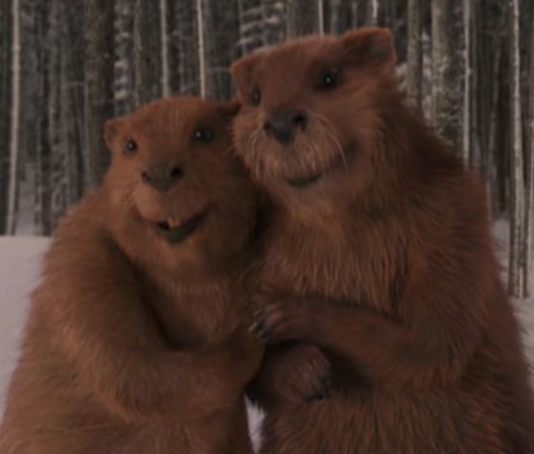 About two years ago, I decided I would destroy monogamy. That's right, I'm one of those people who are out to wreck family values that the `Focus on the Family` bunch warn us all about. Except I deal mostly with animals, so I suppose I'm who `Focus on the Family Castor Chapter` warned us all about.
See, I, in 2005-06, I first began wondering about beavers - no, not that sort. Perverts. Though, I suppose I could write off a lot of things as business expenditures if I was researching them. (I'm done with the bawdy jokes now, honestly). See, the issue with beavers is that they're stereotyped as good old, monogamous, happy family critter. And it's been my experience that when we think that's so, it simply ain't so bob.
For example, for the longest, we assumed a number of species were monogamous. Take Swift Foxes. Swift Foxes are socially monogamous, and mate for life. However, a study showed 52% of offspring were not sired by the apparent mate of the mother (Kitchen et. al 2006). Among Tree Swallows, 50% of broods studied were extra pair young (Lifjeld et. al 1992). Far from being unique, many other species of birds are apparently monogamous, but only insofar as we tend to not catch them cheating on each-other.

Mr. Beaver Began to suspect his wife was less than faithful when
he read papers in the journal Animal Behaviour describing
the rarity of monogamy in actual breeding systems.
Also, that she was cooking someone else's log for dinner was a bit of a hint.
"[...] (although in most cases, this [genetic monogamy] has yet to be confirmed by DNA analysis) [...]" (p.281).Put another way, it says that the remainder of his chapter is based off of a massive, un-validated assumption.
I was flabbergasted that people had poured so much work into a subject, when it was built on such a shaky premise. Sure enough, when I dug through the literature, I found no one had actually done the genetics (and published them) to show that beavers don't cheat on each other behind their flat little tails (I'm not fond of beaver tail, but I recently found it shouldn't be acridic tasting). This astounded me, and I resolve to study it right away.
Hah. Yeah Right.
Well, I never got resources together to look into the issue, but a group from EIU were wrapping up asking the same questions right around the time I decided `honestly! Really! Any day now!` Crawford et. al (2008) decided to sample colonies from south central and south east Illinois between from 2005-2007 using Conibear traps. The sexed them, weighed them, and then aged them. The took just a tiny bit of skin from each one. For a segment of the beavers, they sampled using live-trapping snares. In the end, they got samples from about 127 beavers, which is far more than I'd have been able to wing (I was looking at ~1/2 that, which would make for a less convincing paper.)
After this, they went home and extracted DNA from the skin samples, and then did parent-typing. This is done by looking at small junk regions we call `microsatellites` that are littered liberally throughout the genome. These microsats are of variable size, and so you can use a technique called PCR to make lots of copies of them, and then analyse them in a jell-o like substance and see which copies of the microsats the individual has. As you get one from mom and one from dad, you can then compare what mom and punative-dad had to see if they match. By doing lots of these microsats (Crawford et al did 7 different ones), you can assign a probability that a random individual could be the pup's mother or father. And if the pup has a form of the microsat that the punative father doesn't have at all, it's indicative of that male not being the actual father.
Actual parent typing is a tad more complex than that, but that's actually a good portion of the broad strokes. It's really, actually, quite simple in totality.
And then comes the figure the everyone's looking for. 56% of litters had more than one father. Zadgooks! This is not what they showed us in the Chronicles of Narnia at all! If that movie was to be biologically accurate, Mrs. Beaver would be spending a whole lot of time down at the gym, or showing the plumber where exactly that pipe's broken in the basement for the 3rd time that week.
And that's how it goes for Monogamy, by-and-large. There really aren't that many species that are strictly so, no matter what romantic notions we saddle them with. And why should they? Humans are scarcely monogamous - Jerry Springer's continued existence is testament to this fact, if nothing else! In most situations, it's in a critter's biological interest to mate with as many other males/females as they can get away with. It's sometimes not in their social interest, however, as Mr. Beaver might try to scratch Joe Beaver's eyes out for playing around with his wife. Humans, in the same vein, have firearms.

Joe Beaver suffers a mysterious log-related accident
after visiting Mrs. Beaver one fine afternoon. Mr. Beaver denied
wrongdoing, but in great detail, and before he'd been accused.
Crawford, J.C., Liu, Z., Nelson, T.A., Nielsen., C.K. and Bloomquist, C.K. (2008). Microsatellite analysis of mating and kinship in beavers (Castor canadensis). Journal of Mammalogy, 89(3), pp. 575-581.
Kitchen, A.M., Gese, E.M., Waits, L.P., Karki, S.M., and Schauster, E.R. (2006). Multiple breeding strategies in the swift fox, Vulpes velox. Animal Behaviour, 71(5), pp. 1029-1038.
Lifjeld, J.T., Dunn, P.O., Robertson, R.J., and Boag, P.T. (1992). Extra-pair paternity in monogamous tree swallows. Animal Behaviour, 45(2), pp. 213-229.
Thursday, 7 January 2010
A little bit on animal names.
Avery was asking about a Reindeer on lower campus who hasn't got around to dropping antlers yet, and she brought up a good point. Wildlife terms in English are confusing! Consider this:
- Male Mule Deer are Bucks, Females are Does, Young are fawns.
- Male Moose are Bulls, Females are Cows, and young are calves.
- Male Muskox are Bulls, Females are Cows, and young are calves.
- Male Reindeer/Caribou are Bulls, Females are Cows, young are calves.
- Male Elk are Bulls, Females are Cows, young are calves.
- Male Sheep are called Rams, Females are called Ewes, young are called Lambs.
- Male Goats are either Bucks or Billies, females are Does or Nannies, but young are always Kids, and not fawns!
- Male Wolves are Dogs, Females are Bitches, and young are pups.
- Male Bears are Boars, Females are Sows, youngs are cubs.
- Male Foxes are Todds, Females are Vixens, and young are kits!
March of the Pigs
Alas, it's official: Idaho has feral hogs. There was speculation when I was dwelling (We can't really call it living) in Utah for a bit, that they were down there. Feral hogs are a very hard to manage nuisance species - they're fast breeding, highly aggressive, and very adaptable. I was talking to a lady at the ASM meeting in 2009, who told me the odds of eradication in most states is somewhere between zero and zero. She worked on Texas, specifically, which has a very developed problem.
Wednesday, 30 December 2009

Tuesday, 22 December 2009
Tuesday, 17 November 2009
Man eating lions!

The story goes that in 1898, two male lions in Tsavo, Kenya, formed a coalition and begun eating railway workers - between 28 and 135 of them. After 9 months of attacks, a British field engineer and Officer, Lt. Col. Patterson, hunted down and killed each lion. I'm willing to guess this made him a very popular man. Somehow, these animals eventually ended up in the collection of the Field Museum of Natural History, where people could oggle the Man Eating Lions.
We're supposedly confident that Patterson definitely got the right lions, since the attacks stopped, but how much of the lions' diet was humans? Well, the old phrase that "You are what you eat" is literally true, and different sources of food leave different isotopic signatures. This allows scientists to go in and assay the isotopic ratios to find out what categories of diet an animal ate, and the relative dietary ratios. Using potential prey items as references, they found that one of the lions was eating humans 30% of the time, when it was eating at all. Here's the abstract:
Cooperation is the cornerstone of lion social behavior. In a notorious case, a coalition of two adult male lions from Tsavo, southern Kenya, cooperatively killed dozens of railway workers in 1898. The “man-eaters of Tsavo” have since become the subject of numerous popular accounts, including three Hollywood films. Yet the full extent of the lions' man-eating behavior is unknown; estimates range widely from 28 to 135 victims. Here we use stable isotope ratios to quantify increasing dietary specialization on novel prey during a time of food limitation. For one lion, the δ13C and δ15N values of bone collagen and hair keratin (which reflect dietary inputs over years and months, respectively) reveal isotopic changes that are consistent with a progressive dietary specialization on humans. These findings not only support the hypothesis that prey scarcity drives individual dietary specialization, but also demonstrate that sustained dietary individuality can exist within a cooperative framework. The intensity of human predation (up to 30% reliance during the final months of 1898) is also associated with severe craniodental infirmities, which may have further promoted the inclusion of unconventional prey under perturbed environmental conditions.
Wednesday, 28 October 2009

Thursday, 10 September 2009
Founder Effect
One of the neat things about genetics is it allows us to see things that have long since passed. I don't have a time machine that allows me to investigate the distribution and abundance of moose 20k years ago, but thanks to a basic understanding of how ancestry works, we can infer what they were up to.
Imagine you have a bucket marbles. And these marbles can mate, and have baby marbles of similar colour. Bear with this stupid analogy for a moment.
So you start with a bucket, and the next generation inside that bucket looks a lot like the first. Things are at a balance.
 This turns into that.
Now, let's pretend a new bucket opens up. That is to say, it gets set close to the other bucket, and a few random marbles get to jump into the new one and live out their little marble lives there.
 I've circled the ones that get to jump onto the new bucket.
Now, in our new bucket, only the ones that got there get to make their little marble babies inside the bucket. There are no dark blue or black marbles because they never made it. Just Red, Green, and Light Blue. They are fruitful, multiply, and reach the brim of the second bucket.
 The second bucket looks a lot like this.
Now a THIRD bucket is placed near the second bucket. Why do I have all these buckets? Well, I've got a lot of chores, and I need some for the sink, some for fishing, some for mixing stuff, and some for packing water. Again, only some marbles get to jump into the new bucket, mostly at random.
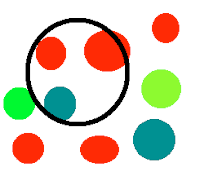 I've just circled one blue and two red. Green doesn't get to go to the new bucket.
Finally, we're down stream at our last bucket, and the founding marbles have little marble babies, and populate the bucket. This leaves us with three things we can compare.
Bucket 1
Bucket 2
 ... and Bucket 3
You can see that each successive colonization results in fewer and fewer colours being represented in the population. The same is true about Genes - obviously it's true, because otherwise why would I make such a dumb analogy. There are other factors at play, which I won't go into, but this is the nut of the Founder Effect. You might realize that this is a special case of a bottleneck, and you'd be right! It's the same principle, where a few number of individuals make up what ends up on the other side. But in this case, your source population is (normally) maintained.
So what you can do is look at the areas where you see animals, and measure their genetic diversity. This'll allow you to puzzle out where a group of animals had their founders. This had actually been done for humans, and it's considered heavy support for the Out of Africa hypothesis - Africa is the centre of human genetic diversity. It's frequently said that there's more genetic diversity in one village in Africa than there is in some whole countries!
But humans are boring. And right now, I'd write about moose, except I've used quite enough words for one post, so I'll postpone it until another.
Imagine you have a bucket marbles. And these marbles can mate, and have baby marbles of similar colour. Bear with this stupid analogy for a moment.
So you start with a bucket, and the next generation inside that bucket looks a lot like the first. Things are at a balance.
 This turns into that.
Now, let's pretend a new bucket opens up. That is to say, it gets set close to the other bucket, and a few random marbles get to jump into the new one and live out their little marble lives there.
 I've circled the ones that get to jump onto the new bucket.
Now, in our new bucket, only the ones that got there get to make their little marble babies inside the bucket. There are no dark blue or black marbles because they never made it. Just Red, Green, and Light Blue. They are fruitful, multiply, and reach the brim of the second bucket.
 The second bucket looks a lot like this.
Now a THIRD bucket is placed near the second bucket. Why do I have all these buckets? Well, I've got a lot of chores, and I need some for the sink, some for fishing, some for mixing stuff, and some for packing water. Again, only some marbles get to jump into the new bucket, mostly at random.
 I've just circled one blue and two red. Green doesn't get to go to the new bucket.
Finally, we're down stream at our last bucket, and the founding marbles have little marble babies, and populate the bucket. This leaves us with three things we can compare.
Bucket 1
Bucket 2
 ... and Bucket 3
 You can see that each successive colonization results in fewer and fewer colours being represented in the population. The same is true about Genes - obviously it's true, because otherwise why would I make such a dumb analogy. There are other factors at play, which I won't go into, but this is the nut of the Founder Effect. You might realize that this is a special case of a bottleneck, and you'd be right! It's the same principle, where a few number of individuals make up what ends up on the other side. But in this case, your source population is (normally) maintained.
So what you can do is look at the areas where you see animals, and measure their genetic diversity. This'll allow you to puzzle out where a group of animals had their founders. This had actually been done for humans, and it's considered heavy support for the Out of Africa hypothesis - Africa is the centre of human genetic diversity. It's frequently said that there's more genetic diversity in one village in Africa than there is in some whole countries!
But humans are boring. And right now, I'd write about moose, except I've used quite enough words for one post, so I'll postpone it until another.
Monday, 27 July 2009
Over-run by foxes.
In all my life, I haven't seen foxes being as brazen as they've been around my home, lately. I hope this means they won't be shy come September! One thing I have to wonder is how they haven't been eaten by an eagle yet...
I don't know enough to make a guess if these foxes are siblings or a mated pair. Your guess is as good as mine!
I don't know enough to make a guess if these foxes are siblings or a mated pair. Your guess is as good as mine!
Tuesday, 21 July 2009
Cauga una?

I was sure that one of my European readers would pipe up with the answer to the skull to the right! Alas, it wasn't the case. Not only is the animal depicted to the right not from the Pleistocene, but it's still around today. Believe it or not, this animal is a deer. Yes, it's a sabre-toothed deer, around and well in the modern world! It's proper name is the Chinese Water Deer (Hydropotes inermis), and obviously it doesn't have a name yugcetun.
I'm really sorry I don't have any pictures for myself of this animal, at least none that aren't in books, but here are two from wikimedia that I can share with you all, to give you an idea what the fang-ity deer look like:


So impressive!
What's interesting is that their family, Cervidae, are known as the antlered deer. However, the Chinese Water Deer lacks antlers throughout its life. Even the Tufted Deer, who's antlers sometimes don't protrude through the head-fur, has a more impresive rack than the Chinese Water Deer. They don't represent an especially old group of animals - my phylogeny on my wall doesn't have them having an especially "basal node," - meaning they didn't split off from from the rest of the deer far back in time. In fact, moose are far more 'basal' than the Chinese Water deer.
These atavistic critters give us clues about how deer probably were like before they evolved antlers. They're largely solitary through most of the year, spending their time in association with wetlands, feeding. However, in the rut the males will periodically encounter eachother, where they try to impress other males with the size and symmetry of their tusks. If they're unimpressed, a bout of often bloody fighting with commence, until either a deer is dead, or runs away. Far be it from them to just mess up eachother, periodically, a Chinese Water deer will sometimes seriously gore a dog in China, or in introduced populations in the UK and France.
Here's one for this week!
 Cauga una? I have no idea what it is, but I'll find out before next tuesday! :p
Friday, 17 July 2009
More foxes.
 A fox showed up just as I was readying to leave for work.
This one is a different fox, since the generous fox was over in the swampy area. Later, a third fox stopped by the edge of the clearing, but bolted. I wonder why they all seem like that gravel pile, or if the one left some scent markings on it.
Kuuvviarsugtua.
Subscribe to:
Posts (Atom)
