Showing posts with label yugcetun. Show all posts
Showing posts with label yugcetun. Show all posts
Monday, 6 December 2010
Vik'ipitiyamun igarluten!
There's now a yup'ik language wikipedia over at http://incubator.wikimedia.org/wiki/Wp/esu/Main_Page It's still in the early stages, and is in need of content - most of what's up there are single lines with a picture or two. Alngaksaitua im'umun mernurama.

Monday, 25 October 2010
Yugcetun demonstratives
A friend of mine went to Montana for graduate studies in linguistics - she's studying to be a speech pathologist - and was apparently in a conversation with someone down there about Yup'ik. She'd told him that Yup'ik has an incredibly elaborate set of demonstratives (ways of saying "This" or "That"), and when she told him that there were 30+ demonstratives, he refused to believe her. :p
But it's true! There are over 30 demonstratives in Yup'ik, not counting all the positional words. Why so many? Well, I got told this explanation about how the tundra is confusing to navigate on, and so the system gets elaborated to work out where things are. I'm not sure if I believe that - I think it's more likely that it's complicated because it's complicated. English has a very complicated and irregular system of plurals, like Goose-Geese, Cow-Cattle, Moose-Moose, Dog-Dogs, and so on. Over time, we lose a lot of the complication in English (the irregular forms are purged), and the same is true with Yup'ik - people use a smaller selection of demonstratives than before. But no one would argue that in English's primordial environment, people had to be very good at quantifying animals. It's just a silly argument.
In grammar person talk, Yugcetun demonstratives can be either 'extended,' 'restricted,' or 'obscured'. That is, they can refer to something at one spot, not moving (restricted), something spread out or moving (extended) or something we can only infer is there (obscured). For example, we have man'a, which is by me (the speaker) in the spread out sort of way. Or unegna, which would translate so elegantly as "that downriver one that is spread out." Pamna would be "that one upslope that you can't see." The translations don't really roll off the tongue in English!
In a simple sentence, I could say "Kan'a Angsaq cukaituq." Which would be "That boat (down below) is slow." With nouns you use them pretty normally, except the plurals get funny. If I wanted to say boats, I'd say Kankut angsat cukaitut... so instead of just changing the ending like most words (Kavirliq->kavirlit) you have to strip it down, add on a -ku- and then you get to end it. Adverbs are even more different.
I've wondered if inupiaq has a similar system of demonstratives, or if it's different. The languages borrow a lot of vocab from each-other, but I'm told the grammar of inupiaq is different in ways. If someone knows, I'd be very curious to hear.
Here's a really cool shirt my friend made for yup'ik demonstratives. He gave me one, and I've worn it around town! :)

But it's true! There are over 30 demonstratives in Yup'ik, not counting all the positional words. Why so many? Well, I got told this explanation about how the tundra is confusing to navigate on, and so the system gets elaborated to work out where things are. I'm not sure if I believe that - I think it's more likely that it's complicated because it's complicated. English has a very complicated and irregular system of plurals, like Goose-Geese, Cow-Cattle, Moose-Moose, Dog-Dogs, and so on. Over time, we lose a lot of the complication in English (the irregular forms are purged), and the same is true with Yup'ik - people use a smaller selection of demonstratives than before. But no one would argue that in English's primordial environment, people had to be very good at quantifying animals. It's just a silly argument.
In grammar person talk, Yugcetun demonstratives can be either 'extended,' 'restricted,' or 'obscured'. That is, they can refer to something at one spot, not moving (restricted), something spread out or moving (extended) or something we can only infer is there (obscured). For example, we have man'a, which is by me (the speaker) in the spread out sort of way. Or unegna, which would translate so elegantly as "that downriver one that is spread out." Pamna would be "that one upslope that you can't see." The translations don't really roll off the tongue in English!
In a simple sentence, I could say "Kan'a Angsaq cukaituq." Which would be "That boat (down below) is slow." With nouns you use them pretty normally, except the plurals get funny. If I wanted to say boats, I'd say Kankut angsat cukaitut... so instead of just changing the ending like most words (Kavirliq->kavirlit) you have to strip it down, add on a -ku- and then you get to end it. Adverbs are even more different.
I've wondered if inupiaq has a similar system of demonstratives, or if it's different. The languages borrow a lot of vocab from each-other, but I'm told the grammar of inupiaq is different in ways. If someone knows, I'd be very curious to hear.
Here's a really cool shirt my friend made for yup'ik demonstratives. He gave me one, and I've worn it around town! :)

Tuesday, 25 August 2009
Caugak ukuk?
Last week, we had this,


Which Flying Fish and Mr. Swift properly IDed as a Three Toed Woodpecker! Mr. Swift even got the Latin right, as it's Picoides tridactylus. Yugcetun, it's puugtuyuli, which is pretty much any woodpecker. Puugtuq- would be something like "divebombing" in English, and if you took a literal translation, puugtuyuli would be 'the one that's really good at divebombing!'
Here's two for this week!
 Caugak ukuk?


Which Flying Fish and Mr. Swift properly IDed as a Three Toed Woodpecker! Mr. Swift even got the Latin right, as it's Picoides tridactylus. Yugcetun, it's puugtuyuli, which is pretty much any woodpecker. Puugtuq- would be something like "divebombing" in English, and if you took a literal translation, puugtuyuli would be 'the one that's really good at divebombing!'
Here's two for this week!
 Caugak ukuk?
Wednesday, 12 August 2009
I named my bunny "suupaq."
Apparently the ANCL here at UAF frequently gets requests for eskimo dog names, so they compiled a short list of suggested names. I bet there's a whole lot of people out there calling their dog "Are-luke" thinking they got an authentic eskimo dog name...
Anyhow, the list caught my eye because of one entry in the Yup'ik section: "Negiliq." For those who don't know, it's a parka ruff (Nacaq is the hood, or mostly a hat these days). That sounds nice, right up to the point you think parka ruffs are often made out of wolf. Yes, it's a lot like naming a horse "Glue." Someone was having a joke on people when they added that one. :)
Anyhow, the list caught my eye because of one entry in the Yup'ik section: "Negiliq." For those who don't know, it's a parka ruff (Nacaq is the hood, or mostly a hat these days). That sounds nice, right up to the point you think parka ruffs are often made out of wolf. Yes, it's a lot like naming a horse "Glue." Someone was having a joke on people when they added that one. :)
Tuesday, 14 July 2009
The Fox that left a gift, and voting in Bethel.
Via The Tundra Drums: A group of people who speak Yup'ik and the ACLU dropped their suit against Bethel for inadequate and incomplete translations on their ballots after the two came to an agreement on ballot translations and having translators on site. Trained translators. Who know that they're translators before election night. People actually willing to translate...
I'm glad they came to that agreement. I'm... disappointed? that it took a lawsuit to make people come to an agreement. Luckily, the ACLU bankrolled it, because lawyers are pricey.
The lawsuit against the state continues, with the State being less open to the idea of equal rights. Who would have thought that it'd be so controversial with the state? (Yes, aside from you...)
Something strange happened to me, yesterday. I've mentioned how there are foxes living around my home. A lot of them. I don't mind it, because they keep the tire eating rabbits on their feet, and none of them have chewed on my tires this year. Well, yesterday at around 11pm, far past my bed time, a fox came up and dropped a young, dead hare in front. I would show you pictures, but no one wants to see pictures of a dead rabbit.
The fox walked around a little bit, before leaving. I have heard of cats bringing dead birds as presents, but foxes bringing presents? I can't figure out what went on, and I think I might just file this as life being weird.
I'm glad they came to that agreement. I'm... disappointed? that it took a lawsuit to make people come to an agreement. Luckily, the ACLU bankrolled it, because lawyers are pricey.
The lawsuit against the state continues, with the State being less open to the idea of equal rights. Who would have thought that it'd be so controversial with the state? (Yes, aside from you...)
Something strange happened to me, yesterday. I've mentioned how there are foxes living around my home. A lot of them. I don't mind it, because they keep the tire eating rabbits on their feet, and none of them have chewed on my tires this year. Well, yesterday at around 11pm, far past my bed time, a fox came up and dropped a young, dead hare in front. I would show you pictures, but no one wants to see pictures of a dead rabbit.
The fox walked around a little bit, before leaving. I have heard of cats bringing dead birds as presents, but foxes bringing presents? I can't figure out what went on, and I think I might just file this as life being weird.
Tuesday, 9 June 2009
Una avelngauguq.
Last week, I left you with these guys:
 This handsome critter (and I use the term loosely) is the Northern Collared Lemming (Dicrostonyx groenlandicus). Yucetun, it's just avelngaq (I took forever to spell that one out. Clearly, I'm not as literate as I hoped. :( ), which covers anything small brown and furry. There's another word for it that starts with ug-, and one that I prefer, but I can't spell it out. It's still `mouse/vole type thing.`
Something I didn't know, but male Collared lemmings scent mark (urinate) on everything, yeah? But they especially like scentmarking bone. We tried to extract DNA from some bony material, and were successful. But when we studied the DNA, we found that it was these guys, and not our species' DNA.
Interesting, there were not supposed to be any Northern Collared lemmings in the area we got the material from. We never quite trust locations people tell us for this sort of stuff, but this is the first time we caught someone blatently lying to us. But not a lot we can do about it! ;)
There's no guessing thing for this week, since I won't be home next Tuesday. So here's an ice age bison (Bison latifrons) from Utah:
 Shame these guys are extinct.
 This handsome critter (and I use the term loosely) is the Northern Collared Lemming (Dicrostonyx groenlandicus). Yucetun, it's just avelngaq (I took forever to spell that one out. Clearly, I'm not as literate as I hoped. :( ), which covers anything small brown and furry. There's another word for it that starts with ug-, and one that I prefer, but I can't spell it out. It's still `mouse/vole type thing.`
Something I didn't know, but male Collared lemmings scent mark (urinate) on everything, yeah? But they especially like scentmarking bone. We tried to extract DNA from some bony material, and were successful. But when we studied the DNA, we found that it was these guys, and not our species' DNA.
Interesting, there were not supposed to be any Northern Collared lemmings in the area we got the material from. We never quite trust locations people tell us for this sort of stuff, but this is the first time we caught someone blatently lying to us. But not a lot we can do about it! ;)
There's no guessing thing for this week, since I won't be home next Tuesday. So here's an ice age bison (Bison latifrons) from Utah:
 Shame these guys are extinct.
Tuesday, 19 May 2009
Caugak ukuk?
For those of you who forgot what we had up for naming, here's the picture again! This is on a lake near my home, and it contains the following!
x2 Bonaparte's Gull (Larus philadelphia). Naruraq (maybe?).
x2 Lesser Yellowlegs (Tringa flavipes) I don't know this one.
x1 Mallard (Anas latyrhynchos), or Curcurpak.
I like ducks much more than I like other birds. Sometimes, you see rpak on the end of animal names, which means big. So does vak, so Qimulvak would be a big dog, and tuntuvak is a big caribou (better known as a moose!). So a mallard is a big curcuq? There's no such word. Or, not anymore. :)
 This if I were to just ask, it would be too easy. These are bears. One is a blackbear, and one is a brown bear.

But which is which? :)
 This is on a lake near my home, and it contains the following!
x2 Bonaparte's Gull (Larus philadelphia). Naruraq (maybe?).
x2 Lesser Yellowlegs (Tringa flavipes) I don't know this one.
x1 Mallard (Anas latyrhynchos), or Curcurpak.
I like ducks much more than I like other birds. Sometimes, you see rpak on the end of animal names, which means big. So does vak, so Qimulvak would be a big dog, and tuntuvak is a big caribou (better known as a moose!). So a mallard is a big curcuq? There's no such word. Or, not anymore. :)
 This if I were to just ask, it would be too easy. These are bears. One is a blackbear, and one is a brown bear.
But which is which? :)
Tuesday, 5 May 2009
Cauga una?
First, some unintentional humour - Someone wrote, about the Eagle flooding, that we won't have a fiasco like Louisiana, because our state isn't crazy.
What planet do they live on? :)
Here's the answer to last week's critters! Arctic Ground Squirrel (Spermophilus parryii), or Cikiq in yup'ik, and apparently Siksrik in Inupiaq.
I know in written yup'ik (which is a whole different beast) there's a bunch of squiggles and archy things that you can't type (Like an arch that goes over ugasek or taugam), but inupiaq there's a lot more of those marks. I wonder how they manage typing it? It probably isn't a big issue - like yugcetun, the writing system is pretty new, and many speakers are probably illiterate in it.
Anyhow, here's cikiq again!
 I love them. I wish Fairbanks had them. Brian Barns, at IAB (my department) has a colony of them for research, but that's not the same.
Here's a tricky one!
 It's an animal I like a lot. It's definitely not found in Alaska - This one was caught in the badlands of Utah, but you could find it's brothers anywhere from Mexico to southern Washington, as well as parts of Alberta and Sasquatch-wan. They can grow fairly large (for a rodent) but are light - 60ish grams, or .1 lbs. The green marker on it's tail is our addition - it's so we know we've trapped it already, if we re-trap it.
 Do you know what these little long-tailed beasts are?
What planet do they live on? :)
Here's the answer to last week's critters! Arctic Ground Squirrel (Spermophilus parryii), or Cikiq in yup'ik, and apparently Siksrik in Inupiaq.
I know in written yup'ik (which is a whole different beast) there's a bunch of squiggles and archy things that you can't type (Like an arch that goes over ugasek or taugam), but inupiaq there's a lot more of those marks. I wonder how they manage typing it? It probably isn't a big issue - like yugcetun, the writing system is pretty new, and many speakers are probably illiterate in it.
Anyhow, here's cikiq again!
 I love them. I wish Fairbanks had them. Brian Barns, at IAB (my department) has a colony of them for research, but that's not the same.
Here's a tricky one!
 It's an animal I like a lot. It's definitely not found in Alaska - This one was caught in the badlands of Utah, but you could find it's brothers anywhere from Mexico to southern Washington, as well as parts of Alberta and Sasquatch-wan. They can grow fairly large (for a rodent) but are light - 60ish grams, or .1 lbs. The green marker on it's tail is our addition - it's so we know we've trapped it already, if we re-trap it.
 Do you know what these little long-tailed beasts are?
Tuesday, 28 April 2009
Caugak ukuk?
Well, some of you told me you all liked this, so here's an easier one. It's got a skull, if you want to go based on that, but also, it's got a reeeeeally recognizable skin:
 You might have seen these on hats, parkas, and a billion other places, because they've got good skins. Be a little more exact that `rodent!` Also, I'm curious what other names exist for these critters.
If you're paying attention, you'd have noticed the title isn't `Cauga una?` That's because there's two of them, so you have to change the question to reflect this. Cauga goes to caugak, and Una for this goes to ukuk for `these two`.
 You might have seen these on hats, parkas, and a billion other places, because they've got good skins. Be a little more exact that `rodent!` Also, I'm curious what other names exist for these critters.
If you're paying attention, you'd have noticed the title isn't `Cauga una?` That's because there's two of them, so you have to change the question to reflect this. Cauga goes to caugak, and Una for this goes to ukuk for `these two`.
Tuesday, 24 March 2009
Put on your what?
Cathy up in Kotz had this really cute video from the TV in the 80s, that was filmed at Noatak. It was so funny how close a lot of the inupiaq words are to the yup'ik words! I thought I should go through and make a list of the yuk words, and how close they were!
- House/Tupiq/Ena - I don't see any relation there.
- Pants/Kamikluuq/Qerrulliik - I wonder how Kamikluuq came to be. I can see a base in there, and then there's 'luuq', which yugcetun is used for bodyparts (luq). Strange. I don't think qerrulliik is the best way to translate the inupiaq, because I think they mean more than pants-pants. I asked, and someone said old time seal pants were ciisqurrilitaq (no promises on spelling!). Not much of those, anymore. Heh. Maybe `Car hart-ak...` or `kaa ggaatak.` ;)
- High boots/Tuttuluuq/Kamguk - People in Hooper Bay say tukellek for foot (instead of it'gaq). Maybe Takete- and Tuttu are relatives?
- Parka/Atigi/Atkuk - Form is similar.
- Hat/Nasaun/Nacaq - Even more similar is nasquq (for head).
- Mittens/Aatakatik/Aritvak - If you say both fast, they feel like the same.
- Winter/Ukiuq/Uksuq - So close!
- School/Aglavik/Elitnaurvik - I think `vik` is the same in both, but they're put on different words. This happens even in different yup'ik areas, for things that weren't around before the Russians.
Thursday, 12 March 2009
Morning disarray.
Well, I'm writing this post while being distracted by Dave's `find the birds` picture. I've found one of the two stealthy birds, which leaves just one between me and fabulous prizes. Also, I'm fending off the urge to cook up some spam and eggs, after another blog on my list got spammed. Here's some random thoughts:
- I will not touch this story with a 10 foot not touching pole, exactly as I predicted.
- Scientists in Russia have found some of the missing Romanov children. Of course, this won't stop any conspiracy nuts out there, who'll say the Real Tsar is still out there. :)
- I haven't had a chance to read the decision, but the Board of Game is allowing moose hunt on the lower Kuskokwim again. I'll read at how many, and exactly what areas when I'm at work. I understand the huge pressure to open this area up to hunting again, since it's a critical subsistence resource. But my wildlife management side of my brain hopes that it's sufficiently limited this year, so they can recover even more.
- I had a strange dream that I was getting an award for launching a young teen through the air and getting them through a hoop using a catapult and explosives. Like a free-throw contest but with people. Usvipaa. The stranger thing is that in my dream, there was a Red-Head I once knew a long time ago, named Charlie. Except I could only call him Kavirliq, which means `red stuff.` Pretty much every redhead has that as a name. Or all the ones I know - three that I personally know are Kavirliq, and two people who I have never met (one of which is sadly passed on).
Thursday, 5 February 2009
Seal Control
This doesn't explain why there was less support for predator control than expected in areas currently asking for predator control, but the mistranslation sure is good for a laugh. :)
Sadly, 90% of the comments to the stories are from racist assholes:
Sadly, 90% of the comments to the stories are from racist assholes:
Assimilation should be encouraged. The government does people a disservice when it enables their failed cultures to hang on a little longer.The other 10% consists of people saying `holy hell, you're racist assholes.`
Wednesday, 10 December 2008
"Iqmigyugtuten-qaa? Ugh."
The title comes from a conversation I overheard a few months ago. One that gives me a bit of hope. Arctic Economics has a great story on iqmik use in the K-Y. Iqmik is doped chew, or as someone once described it (thus endearing me to them), `nasty shit.` People from outside the area are frequently struck by just how many people chew out there, even given that the level of chewing in Alaska is higher to begin with. It's lead to a big of an oral fixation, I think - I've been offered chew, and when people figured out I don't, I've been very frequently offered gum. Very frequently. Some folks carry around great big packs of gum around with them. I guess what I'm saying is it's a lot of gum.
I hadn't even been slightly tempted to touch the stuff. My father and grandfather had active roles in tobacco cultivation, and I've seen enough of it to want nothing to do with tobacco. My father talked about how sometimes they'd get ill just putting it in the barn for drying. And if this isn't the case (he sometimes reads my blog) I don't want him to correct me, because it's a factor in keeping me away from it.
Anyhow, I strongly recommend you check out the story.
I hadn't even been slightly tempted to touch the stuff. My father and grandfather had active roles in tobacco cultivation, and I've seen enough of it to want nothing to do with tobacco. My father talked about how sometimes they'd get ill just putting it in the barn for drying. And if this isn't the case (he sometimes reads my blog) I don't want him to correct me, because it's a factor in keeping me away from it.
Anyhow, I strongly recommend you check out the story.
Thursday, 27 November 2008
Quyavigmi
- Quyavikagka Steve-aq Kumaggaq-llu. Quyana elitnaurlua.
- Quyavikanka ilanaaranka. Quyana ikayuristeńguluten.
- Quyavikaqa Kavirliq. Assikamken assiilkellua-llu. Pinrirsaqunak!
- Quyavikanka tuntut, tuntuviit, neqet, ȗgaseget-llu. Quyana tuquluci.
- Quyavikanka ilanka. Pitsaqkenritamci assiillua.
- Quyavikanka naaqistenka!
Wednesday, 5 November 2008
`Ii-i, piyugngaukut!`
@Wal was talking to his students, trying to be encouraging. I had to fight off less than helpful inclinations.
"What did Obama say yesterday?"
"Uh, `I'm president?`"
"Nuu. He said `Ii-i, piyugngaukut!`" *writes it down.*
I think to myself . o O( I think I would have noticed it, if he said that. )
The moral of the story is that sometimes, it's good to keep your mouth shut. :)
Also, I kinda like that. I tried to look around to see if someone translated `Yes we can!` in to a whole bunch of languages so I could toss that their way, but it looks like no one has, beyond `Sí se puede.` Even if you're not fond of the guy, or sceptical of his politics, it's a nice message. So here we go:
English -----Yes, We can!
Spanish ----Sí se puede!
Yugcetun---Ii-i, piyugnaukut!
German----Ja, wir können!
Latin-------Certe, possumus!
Japanese--ええ、できる!
Russian----Да мы можем
Esperanto-Jes, ni povas!
Romanian-Da putem!
Mandarin--我们做得到
French-----Oui, on peut!
Swedish----Ja, vi kan!
Italian------Sí, possiamo!
Most of this is from other people, If you have any corrections to make, or one to add, leave a comment! :}
"What did Obama say yesterday?"
"Uh, `I'm president?`"
"Nuu. He said `Ii-i, piyugngaukut!`" *writes it down.*
I think to myself . o O( I think I would have noticed it, if he said that. )
The moral of the story is that sometimes, it's good to keep your mouth shut. :)
Also, I kinda like that. I tried to look around to see if someone translated `Yes we can!` in to a whole bunch of languages so I could toss that their way, but it looks like no one has, beyond `Sí se puede.` Even if you're not fond of the guy, or sceptical of his politics, it's a nice message. So here we go:
English -----Yes, We can!
Spanish ----Sí se puede!
Yugcetun---Ii-i, piyugnaukut!
German----Ja, wir können!
Latin-------Certe, possumus!
Japanese--ええ、できる!
Russian----Да мы можем
Esperanto-Jes, ni povas!
Romanian-Da putem!
Mandarin--我们做得到
French-----Oui, on peut!
Swedish----Ja, vi kan!
Italian------Sí, possiamo!
Most of this is from other people, If you have any corrections to make, or one to add, leave a comment! :}
Saturday, 1 November 2008
Uitaukut Cauyarvigmi
Well, it's the first of November, and that means the start of most Furbearers' season in the Interior. I've been talking to various folks, getting an idea of who's where, and so forth, and I noticed there's a lot of new people in it right now. I think this has something to do with the incredible price of furs - I'm just flabbergasted that prices have managed to remain this high. Someone said it's all the people in SE Asia buying up furs like there's no tomorrow. Weird - I would have thought they'd be luxury goods, and the first to go.
Luckily, most of the new folks are trapping in weird places. Not very good places. For example, apparently there's two guys running lines through Murphey Dome, on the State Land side of it. Yeah, you can get there easily, but you can't get much more awful places to try and find anything. There's a few foxes, but that's it. Because of these `novel` lines, I'm not too worried about the prices going down due to a glut. Nor am I especially worried about over-harvesting the area.
By the by. October was Qaariitaarvik - place for Qaariitaaq, which is yugcetun for Halloween. Qaariitaaq predates the arrival of kass'at to AK, and very closely resembles how we practice Halloween now. Kinda one of those neat cosmic coincidences. It's part of why Halloween is such a thing in the YK.
Now, November is Cauyarvik. Waniwa cauyarviuguq - Now's the time of drumming.
Some people think that the Yup'ik calendar has 12 months, so does the Kass'at, is a big coincidence. But, they're forgetting that there are twelve lunar months in a solar year, so that's how so many people cameup with the same 12-month thing.
And now you know!
Luckily, most of the new folks are trapping in weird places. Not very good places. For example, apparently there's two guys running lines through Murphey Dome, on the State Land side of it. Yeah, you can get there easily, but you can't get much more awful places to try and find anything. There's a few foxes, but that's it. Because of these `novel` lines, I'm not too worried about the prices going down due to a glut. Nor am I especially worried about over-harvesting the area.
By the by. October was Qaariitaarvik - place for Qaariitaaq, which is yugcetun for Halloween. Qaariitaaq predates the arrival of kass'at to AK, and very closely resembles how we practice Halloween now. Kinda one of those neat cosmic coincidences. It's part of why Halloween is such a thing in the YK.
Now, November is Cauyarvik. Waniwa cauyarviuguq - Now's the time of drumming.
Some people think that the Yup'ik calendar has 12 months, so does the Kass'at, is a big coincidence. But, they're forgetting that there are twelve lunar months in a solar year, so that's how so many people cameup with the same 12-month thing.
And now you know!
Friday, 24 October 2008
Icky Bears
 This is, without a doubt, the worst bear mount I've seen. Not just slightly bad, pretty horrifically bad. It excels at being awful. Wow.
And, naturally, the museum has it nice, front and centre for tourists to see it first thing when they arrive.
So the museum has this thing on hunting and trapping in Alaska, and I'm tempted to see it before they pack it up. I'm told that it's actually a good exhibit, and from people aren't... well, they aren't the usual museum going crowd. They've also had periodic events at the museum for adults and kids. You can visit the calendar to see upcoming events - most of them are free to the public.
Oh. Side note. A trusted source™ has told me that it's pal'tuuq. That's what I'm sticking with. Heh. Forget words for snow (which there aren't many for), darn language has far too many words for clothing! ;)
Wednesday, 22 October 2008
Bullet point style.
- Palin says the election is in the hands of God. I suspect the voters have a say, too. I don't like this kinda talk. Because if they win, they say God wants them to win. If they lose, they never said God cost them the election. And it brings up the whole `knowing the mind of God` thing.
- Apparently paltuuk is pal'tuuk, and not uligaaq. Except it might be ullirtaaq. I'm confused! (Qanerlartut uligaaq wall' ullirtaaq? Naam!)
- The fresh snow means all the tracks are gone. Aw. :( I need to get a roll of feild tape to flag areas I want to return to.
Thursday, 9 October 2008
Brr!
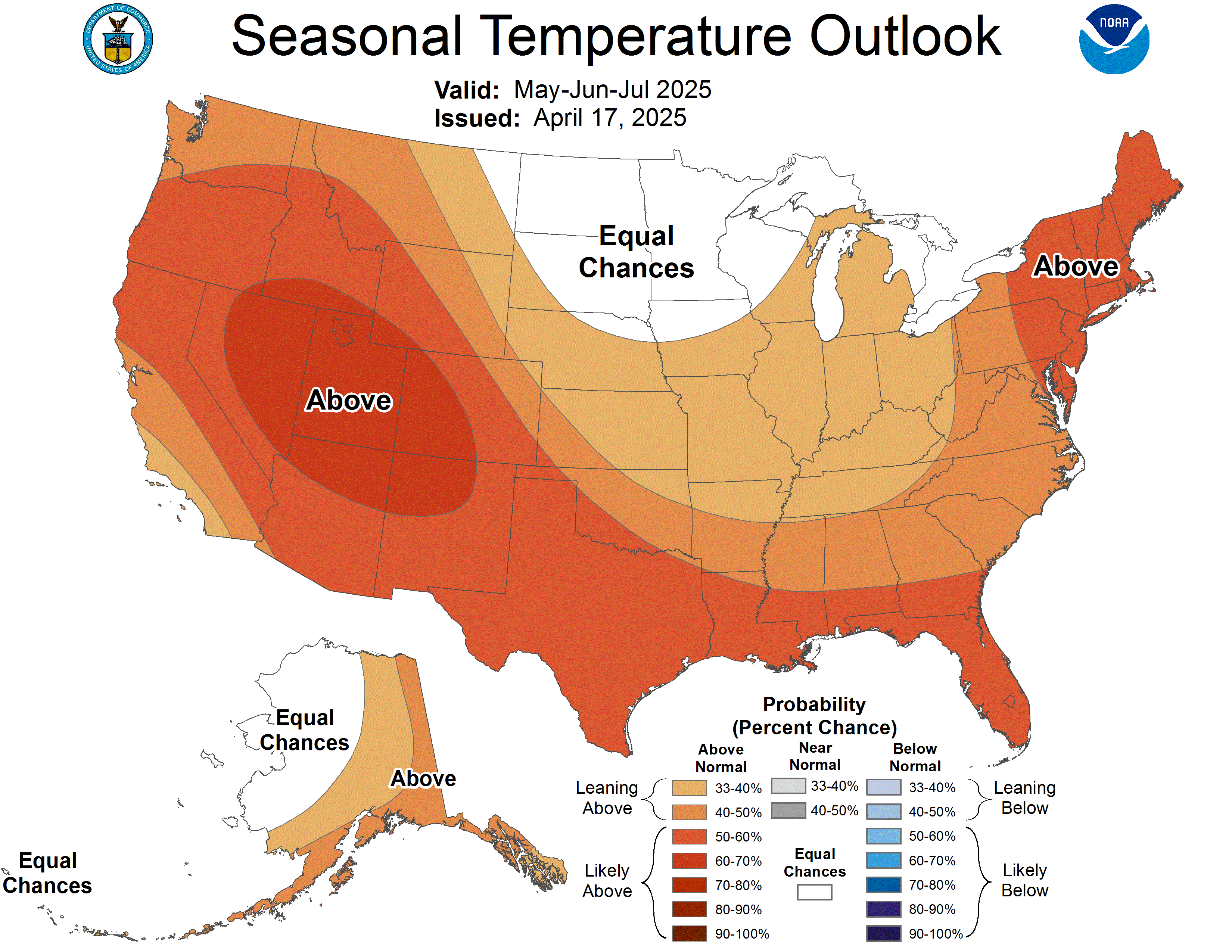
My weather thingy said it was -17°C this morning. I thought it felt a little cold when I went to clear my truck. CPC says this won't be an abnormally cold winter, and they're usually accurate, but right now they sure feel wrong!
Here's yugcetun word for your use: Alapaa! So cold! It's one that gets a bit of a work out around here, eh? :)
And now you speak yupik!
Here's yugcetun word for your use: Alapaa! So cold! It's one that gets a bit of a work out around here, eh? :)
And now you speak yupik!
The river has two eyes.
A newspaper in Saginaw Michigan, appro nothing, wrote fairly well about what Eek (a village in the Y-K) is like. It's not a perfect story, but not bad for a newspaper about 7,000 miles away. Arctic Economics makes a good point, that in the story focuses on the subsistence economy, with little focus on the cash economy that these days has to be there to support the subsistence economy. For good or for ill, the subsistence lifestyle has got tied up to things that require money. Hunting isn't cash-free anymore.
The BIA did lots of things wrong. I think there's more than a few books out there on `how the BIA ruined the world,` but to that list I'd add that they, and the ANCSA, forced a bunch of Alaska Natives thoroughly into cash economies without any support for the fledgling economies. If you're going to change over spending money for things as an important part of your lively hood, you better darn well have money, eh? This never happened.
Walkie asked me, not long ago, 'bout my attitude towards the fate of Yugcetun, and about what I thought could be done to protect the language and culture. My answer to the latter was a very quick `Jobs!` Even people in nowhere-Mongolia need jobs, if they're buying stuff. A few high paying jobs, like IT, or other sorts of work that it doesn't matter where you do it, and you don't just support a single family, but the money will slosh through the village. Sort of like it does on the state level when you spend locally.
There's pretty much only one way the cash economy would go at this point, and that's if there's a total collapse of the US. Which isn't good. Baring that, without the right fiscal inputs, it'll kill villages. Right now a lot of the lower parts of the YK primarily get their money through commercial fishing permits. But the margin on these jobs is not high enough to really allow other people in the village to continue to engage in subsistence activities when times are bad like this, so they emigrate to Anchoragua. The problem is money isn't letting them decide to continue living as they want. That hurts the long term survival of both the language and the culture more than satellite TV ever could or will.
Oh, hey, you know that your thinking is starting to get warped when you don't think Eek is especially remote, or isolated.
The BIA did lots of things wrong. I think there's more than a few books out there on `how the BIA ruined the world,` but to that list I'd add that they, and the ANCSA, forced a bunch of Alaska Natives thoroughly into cash economies without any support for the fledgling economies. If you're going to change over spending money for things as an important part of your lively hood, you better darn well have money, eh? This never happened.
Walkie asked me, not long ago, 'bout my attitude towards the fate of Yugcetun, and about what I thought could be done to protect the language and culture. My answer to the latter was a very quick `Jobs!` Even people in nowhere-Mongolia need jobs, if they're buying stuff. A few high paying jobs, like IT, or other sorts of work that it doesn't matter where you do it, and you don't just support a single family, but the money will slosh through the village. Sort of like it does on the state level when you spend locally.
There's pretty much only one way the cash economy would go at this point, and that's if there's a total collapse of the US. Which isn't good. Baring that, without the right fiscal inputs, it'll kill villages. Right now a lot of the lower parts of the YK primarily get their money through commercial fishing permits. But the margin on these jobs is not high enough to really allow other people in the village to continue to engage in subsistence activities when times are bad like this, so they emigrate to Anchoragua. The problem is money isn't letting them decide to continue living as they want. That hurts the long term survival of both the language and the culture more than satellite TV ever could or will.
Oh, hey, you know that your thinking is starting to get warped when you don't think Eek is especially remote, or isolated.
Subscribe to:
Posts (Atom)
